

For DIY enthusiasts in 2025, the top seven sensor kits include the ELEGOO 37 in 1, HiLetgo 37 Sensor Assortment, and the Sensor Modules Kit featuring 22 sensors. You’ll also find the extensive 37/Set Kit and KEYESTUDIO 48 Sensors Starter Kit perfect for students. Don’t miss the SunFounder Universal Maker Sensor Kit and the 38 in 1 Sensor Module kit which are great for experiments. Keep exploring to find out more about these essential tools!
ELEGOO 37 in 1 Sensor Modules Kit for Arduino

If you’re a DIY enthusiast looking to plunge into the world of electronics, the ELEGOO 37 in 1 Sensor Modules Kit for Arduino is an excellent choice. This kit boasts compatibility with various Arduino models and includes 37 essential components like the GY-521 accelerometer and LCD1602 screen. With an upgraded tutorial designed for beginners, you’ll find it easy to start your projects. Just keep in mind that some users did report missing components or the need for additional libraries. Overall, it’s a highly-rated kit, making it a solid investment for your electronics journey. Happy tinkering!
Best For: DIY enthusiasts and beginners looking to explore electronics and programming with Arduino and compatible platforms.
Pros:
- High-quality components with a variety of sensors included for diverse projects.
- Upgraded tutorial designed for beginners, making it easy to get started.
- Generally positive customer feedback, highlighting the organization and usability of the kit.
Cons:
- Some components may arrive malfunctioning or missing.
- Users may need to find additional libraries for certain sensors independently.
- Basic electronic knowledge is required, which might be challenging for absolute beginners.
HiLetgo 37 Sensor Assortment Kit for Arduino & Raspberry Pi

The HiLetgo 37 Sensor Assortment Kit is perfect for beginners diving into the world of electronics and programming. With 37 modules, including touch sensors, temperature sensors, and various LED types, you’ll have everything you need for diverse projects. It’s designed for Arduino and Raspberry Pi, making it versatile for your learning journey. Most sensors are plug-and-play, so you can start experimenting right away. Although some users noted issues with documentation and component organization, the kit’s functionality has received positive feedback. You’ll appreciate the educational value it offers, especially with a customer rating of 4.4 out of 5 stars.
Best For: Beginners in electronics and programming looking for a versatile kit to explore various projects with Arduino and Raspberry Pi.
Pros:
- Many sensors are plug-and-play, allowing for quick setup and experimentation.
- A wide variety of components, including touch and temperature sensors, enhances learning opportunities.
- Positive feedback on sensor functionality and the overall educational value of the kit.
Cons:
- Some users reported issues with documentation and lack of clear instructions for specific sensors.
- Concerns about quality control and the build quality of certain components.
- Mixed reviews regarding the organization of components within the carrying case.
Sensor Modules Kit for Arduino Raspberry (22 in 1 Project Starter Kit)
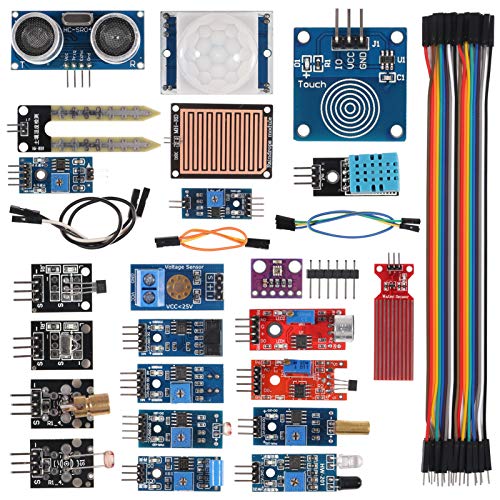
Designed specifically for beginners, the Sensor Modules Kit for Arduino and Raspberry Pi offers an impressive 22-in-1 selection of sensors that make it perfect for anyone enthusiastic to immerse themselves in DIY electronics projects. You’ll find high-quality sensors like the DHT11 for temperature and humidity, the HC-SR04 ultrasonic sensor, and the soil moisture sensor, among others. Weighing just 3.52 ounces, this compact kit is easy to handle. While some users have raised concerns about packaging and instructions, the overall customer feedback highlights reliability and great value. Plus, enjoy peace of mind with a solid return policy if needed.
Best For: Beginners looking to explore Arduino and Raspberry Pi projects through a comprehensive selection of sensors.
Pros:
- High-quality sensors included for reliable performance in various projects.
- Compact and lightweight design for easy handling and storage.
- Positive user feedback on functionality and overall value for money.
Cons:
- Some concerns regarding packaging quality and clarity of instructions.
- Mixed experiences reported with sensor defects by a few users.
- Limited detailed documentation for beginners may require additional research.
37/Set Sensor Assortment Kit for Arduino
Product not found or API error.
For electronics enthusiasts and beginners enthusiastic to immerse themselves in the world of Arduino, the 37/Set Sensor Assortment Kit stands out as an invaluable resource. With 37 diverse sensor modules, it offers everything from temperature and humidity sensors to infrared and flame detectors, perfect for a variety of projects. While many users appreciate the value for prototyping, some report issues with packaging, like bent pins and missing components. To maximize your experience, consider organizing the sensors better and seek additional documentation for guidance. Overall, this kit is a fantastic choice for experimenting and expanding your Arduino knowledge.
Best For: Electronics enthusiasts and beginners looking to explore Arduino with a wide variety of sensor modules.
Pros:
- Comprehensive assortment of 37 different sensor modules ideal for diverse project needs.
- Great value for prototyping and replenishing sensor inventory.
- Suitable for learning and experimentation in Arduino and other controllers.
Cons:
- Packaging issues reported, including bent pins and damaged components.
- Lack of individual packaging for each sensor leading to potential damage.
- Insufficient documentation and instructions for some sensors.
KEYESTUDIO 48 Sensors Modules Starter Kit for Arduino

A treasure trove for aspiring inventors, the KEYESTUDIO 48 Sensors Modules Starter Kit for Arduino offers an impressive assortment of 48 sensors and modules, making it perfect for junior high and high school students ready to plunge into the world of electronics. Compatible with various microcontrollers, this kit features gas sensors, sound sensors, and more. Each module comes neatly packaged on a quality PCB, ensuring durability. Detailed projects and tutorials simplify your learning experience. While the Arduino controller isn’t included, you’ll find that the setup encourages creativity and innovation. With a solid 4.4-star rating, it’s a fantastic choice for young tinkerers.
Best For: The KEYESTUDIO 48 Sensors Modules Starter Kit for Arduino is best for junior high and high school students eager to explore electronics and robotics through hands-on projects.
Pros:
- Wide Variety: Includes 48 different sensors and modules, providing ample options for diverse projects.
- Comprehensive Tutorials: Detailed projects and tutorials are available to guide users through the setup and coding process.
- Durable Packaging: Each module is mounted on a quality PCB, ensuring longevity and ease of use.
Cons:
- Arduino Not Included: The kit does not come with an Arduino controller, which is necessary for operation.
- Documentation Issues: Some users reported inconsistencies in wiring diagrams and example codes, which can lead to confusion.
- Additional Components Needed: Initial setup may require extra wires and components not included in the kit, potentially increasing costs.
SunFounder Universal Maker Sensor Kit for Arduino and Raspberry Pi

The SunFounder Universal Maker Sensor Kit stands out as the perfect choice for DIY enthusiasts looking to explore the worlds of Arduino and Raspberry Pi. With compatibility across various models, this kit boasts over 25 sensors, actuators, and display modules, enabling you to tackle 169 exciting projects. You’ll find step-by-step tutorials in C/C++ and Python, catering to all skill levels. Plus, a supportive community forum offers ongoing assistance. While some users noted packaging issues, the kit’s average rating of 4.6 stars speaks volumes. Immerse yourself in environmental monitoring, smart home automation, and robotics with this versatile kit!
Best For: DIY enthusiasts and learners interested in exploring Arduino and Raspberry Pi projects.
Pros:
- Wide Compatibility: Supports various models of Arduino and Raspberry Pi, enhancing versatility.
- Comprehensive Tutorials: Step-by-step guides for all skill levels in both C/C++ and Python.
- Community Support: Ongoing assistance through a community forum for troubleshooting and project ideas.
Cons:
- Packaging Issues: Some users reported difficulties in identifying components due to poor labeling and organization.
- Weight: At 1.7 pounds, the kit may be heavier than expected for portable projects.
- Limited Warranty Information: Warranty details are not explicitly stated, which may concern some buyers.
38 in 1 Sensor Module kit for Arduino Rapsberry Pi Project
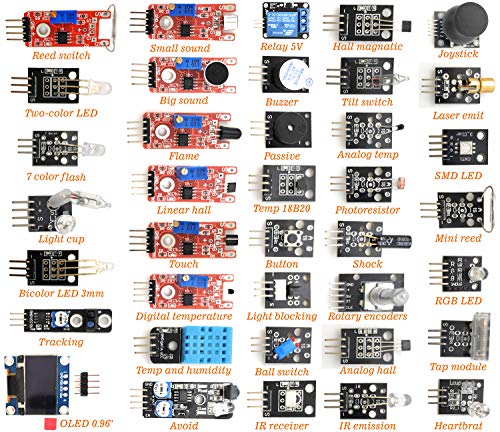
Whether you’re a budding inventor or a seasoned DIY enthusiast, the DEYUE 38 in 1 Sensor Module Kit stands out as an ideal choice for Arduino and Raspberry Pi projects. This extensive kit includes 38 different sensors, an OLED display, and a handy leaflet, all neatly packed in a plastic box. It’s fully compatible with major platforms, making it perfect for your next project. While it requires basic electronics knowledge, a wealth of online tutorials can guide you. However, keep in mind that some sensors may not meet standard expectations, and organization could be better. Enjoy exploring endless possibilities!
Best For: DIY enthusiasts and beginners looking to explore a wide range of sensors for Arduino and Raspberry Pi projects.
Pros:
- Comprehensive kit with 38 different sensors, providing a wide range of experimentation options.
- Fully compatible with popular platforms like Arduino UNO, MEGA 2560, and Raspberry Pi.
- Includes an OLED display and access to online tutorials for easy learning.
Cons:
- Some sensors may differ from standard expectations, leading to potential confusion.
- Organization of components in the box could be improved for easier access.
- Lacks specific sensors like gas, ultrasonic, and motion sensors, which may limit certain projects.
Factors to Consider When Choosing Sensor Kits
When you’re choosing a sensor kit, consider how well it works with your platforms like Arduino or Raspberry Pi. Also, think about the number of sensors included and the quality of the documentation and tutorials available. Finally, don’t overlook the build quality and how the kit is packaged and organized for your projects.
Compatibility With Platforms
Choosing the right sensor kit hinges on its compatibility with your preferred microcontroller platforms, like Arduino, Raspberry Pi, or STM32. Make sure the kit you select works seamlessly with your specific hardware, as different kits may only support certain Arduino models—like UNO R3, MEGA 2560, or NANO. If you’re looking for versatility, consider kits that offer broader compatibility across platforms, allowing you to experiment with various systems. Also, check that the sensors come with libraries supported by your chosen platform, as this will greatly ease implementation. Kits that explicitly mention compatibility with both Arduino and Raspberry Pi typically provide a wider range of educational opportunities, enhancing your project options and overall DIY experience.
Number of Included Sensors
The number of included sensors in a kit greatly impacts your ability to explore a wide range of projects. Kits typically offer between 22 to 48 sensors, and those with 37 or more can provide a broader array of functionalities. This variety allows you to experiment with diverse applications, from environmental monitoring to robotics. Some kits even include unique sensors like accelerometers or real-time clock modules, enhancing your learning experience and offering advanced project opportunities. A larger number of sensors means you can conduct more complex experiments, deepening your understanding of sensor technologies. So, when choosing a sensor kit, keep in mind that the number of sensors directly correlates with your potential for learning and experimentation in electronics and programming.
Documentation and Tutorials
How important is thorough documentation and tutorials when selecting a sensor kit? It’s essential! Many sensor kits cater to beginners, offering step-by-step instructions and example projects that make learning enjoyable. Look for kits that include additional resources, like CDs or online access to detailed guides, which help you grasp each sensor’s functionalities. However, be aware that a basic understanding of electronics is often assumed, as many tutorials cover wiring and programming concepts. The quality of documentation can vary greatly; some kits may lack detailed instructions, hindering your progress. You might also need to seek external resources or community support for specific sensors, as not all tutorials address every component in your kit. Choose wisely for a smoother learning experience!
Build Quality and Durability
When you’re diving into the world of sensor kits, build quality and durability are crucial factors that can make or break your project. High-quality materials, like robust PCBs and protective casings, guarantee your components can handle physical stress and everyday use. Look for kits where sensors are individually packaged; this helps prevent bent pins and other defects that could hinder performance. Pay attention to warranties and return policies, as they often reflect a manufacturer’s confidence in their product’s durability. Finally, check user feedback on build quality to identify common issues, guiding you toward kits that have proven reliable. Prioritizing these factors will save you time and frustration in your DIY endeavors.
Packaging and Organization
Choosing a sensor kit with well-thought-out packaging and organization can greatly enhance your DIY experience, as disorganized components can lead to frustration and potential damage. Kits that lack individual packaging often result in missing parts or tangled wires, which can bend pins and compromise your sensors. Look for kits with clear labeling and compartmentalization, as this makes it easier to quickly locate and access the sensors you need. Customer feedback frequently points out issues with packaging quality, where inadequate protection during shipping causes physical damage. By selecting a kit with improved packaging that isolates fragile parts, you can guarantee that all components arrive intact and ready to use, reducing the likelihood of dissatisfaction with your purchase.
Learning Curve for Beginners
While venturing into the world of DIY electronics, it is crucial to take into account the learning curve that comes with using sensor kits, especially for beginners. Look for kits that include thorough tutorials and documentation; these resources can greatly ease your learning process. Opting for plug-and-play sensors can also help, as they require minimal setup, allowing you to dive straight into experimentation. A variety of sensor types will broaden your understanding of different applications in projects. Additionally, choose kits that provide clear wiring diagrams and example codes to assist with initial setups. Finally, consider customer reviews; kits with positive feedback often indicate a user-friendly experience, making them ideal for those who might struggle with technical concepts.
Price and Value Comparison
Understanding the price and value of sensor kits is vital for making a smart investment in your DIY projects. Prices can range from around $22 for smaller kits to over $50 for more extensive options. When evaluating value, consider the number and variety of sensors included; kits with 37 or more sensors offer greater functionality for diverse projects. Customer ratings also matter—look for kits with ratings above 4.4 stars, as they indicate higher satisfaction and reliability. Additionally, packaging quality can impact your experience; well-organized kits prevent damage during shipping, leading to fewer complaints. While warranty and return policies are important, make sure you prioritize these aspects to enhance your overall value when selecting a sensor kit.
Return and Warranty Policies
When selecting a sensor kit, it is important to pay attention to the return and warranty policies, as these can greatly impact your overall satisfaction with the purchase. Most kits offer a 30-day return policy for defective or damaged items, giving you peace of mind. However, keep an eye out for specific conditions, like restocking fees for items not returned in their original condition. Warranty details might not always be clear in the product description, so don’t hesitate to ask for clarification. It’s also wise to check customer reviews regarding warranty claims and return experiences, as these can vary widely. Understanding the return policy helps you feel secure in your investment, especially if you’re new to electronics.


