

When you’re choosing the best robot bases for your next DIY project, consider options like the Mecanum Robot Chassis Car Kit and Waveshare Wave Rover 4WD chassis. These offer durability, customizability, and excellent mobility. Plastic model bases can enhance your tabletop gaming, while the Smart Robot Car Chassis Kit is perfect for Arduino and Raspberry Pi enthusiasts. Assess factors such as weight, load capacity, and assembly complexity to find the right fit for your needs, and there’s still more to explore!
100Pcs 28.5mm Plastic Model Miniature Bases for Gaming Miniatures

If you’re into tabletop gaming and need reliable bases for your miniatures, the 100 Pcs 28.5mm Plastic Model Miniature Bases are a fantastic choice. These sturdy acrylic bases are lightweight yet durable, ensuring your miniatures stay securely in place. At 4mm thick, they offer stability without compromising on design. The minimalist look works well for various styles, making them perfect for role-playing games like D&D. Plus, their precise cutting allows for easy bonding with tapes or glue. With a 4.6-star rating from satisfied customers, you’ll find these bases an excellent value for your gaming needs.
Best For: Those seeking reliable and durable bases for tabletop gaming miniatures, particularly for role-playing games like D&D.
Pros:
- Made from lightweight and sturdy acrylic, ensuring durability and resistance to breakage.
- Precise cutting allows for uniformity and stability, making it easy to bond with tapes or glue.
- Highly rated by customers for value and quality, suitable for various gaming applications.
Cons:
- Figures are not included, requiring separate purchase of miniatures.
- Limited to a specific base size (28.5mm), which may not fit all miniatures.
- Some users may prefer more decorative or themed bases over minimalist designs.
Mecanum Robot Chassis Car Kit (Unassembled)

The Mecanum Robot Chassis Car Kit (Unassembled) is an ideal choice for aspiring robot enthusiasts aged 14 and up, thanks to its innovative 360° omnidirectional wheels that allow for seamless movement in any direction. Weighing only 1.1 pounds, this durable aluminum alloy frame supports a load capacity of 1500g. Equipped with four TT motors, it delivers impressive torque and speed. You can easily customize it with components like Raspberry Pi or Arduino, fostering creativity. While assembly is generally straightforward, some users mention needing extra resources for instructions. With a solid 4.4-star rating, you’ll find quality and support from Lewansoul.
Best For: Aspiring robot enthusiasts aged 14 and up looking for a customizable and durable robotic platform.
Pros:
- 360° omnidirectional wheels allow for seamless movement in all directions, making it suitable for narrow spaces and rough terrains.
- Strong load capacity of 1500g supported by a durable aluminum alloy frame enhances structural integrity and performance.
- Customizable with electronic systems like Raspberry Pi or Arduino, fostering creativity and expansion in robotic projects.
Cons:
- Some users report minor issues with assembly instructions, indicating a need for additional resources.
- Compatibility issues with motor drivers have been noted by a few customers.
- Assembly may require proper tools, which could deter beginners without access to necessary equipment.
Robot Tracked Tank Car Chassis for DIY Smart Robots
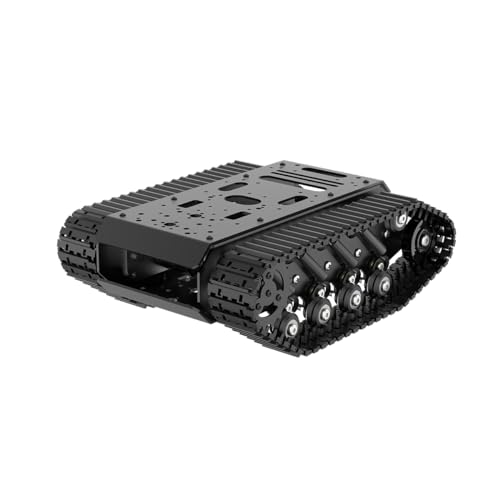
For hobbyists and educators looking to immerse themselves in the world of robotics, the Robot Tracked Tank Car Chassis stands out with its sturdy aluminum alloy build and multiple expansion ports. Weighing just 3.78 pounds and measuring 11.8 x 9.05 x 4.88 inches, it’s compatible with Arduino, Raspberry Pi, and Jetson Nano. Its robust design features encoder DC motors and a suspension system that helps reduce vibrations. While it’s an excellent learning tool for various projects, be mindful that it struggles with heavy payloads and off-road conditions. Overall, it’s a solid choice for your DIY smart robot endeavors.
Best For: Hobbyists, educators, and students looking to explore robotics with a robust and customizable chassis.
Pros:
- Sturdy aluminum alloy construction enhances durability and performance.
- Multiple expansion ports allow for easy addition of sensors and servos for DIY projects.
- Compatible with popular programming environments like Arduino and Raspberry Pi, facilitating diverse project possibilities.
Cons:
- Struggles with payloads exceeding 5kg, limiting heavy-duty applications.
- Poor off-road performance and suspension issues can affect usability in varied terrains.
- Documentation quality is criticized for being poorly organized, with some resources available only in Chinese.
Waveshare Wave Rover 4WD Mobile Robot Chassis

Engineered for versatility, the Waveshare Wave Rover 4WD Mobile Robot Chassis stands out as an excellent choice for DIY enthusiasts and educators alike. Its robust metal body guarantees durability, while the four N20 geared motors offer impressive speed and off-road capabilities. Weighing just 2.6 pounds, it’s lightweight yet sturdy. You can connect it to multiple host computers, like Raspberry Pi, thanks to the onboard ESP32 module. Although it lacks advanced features and documentation can be sparse, its open-source nature allows for customization. Priced around $99, it’s a cost-effective entry point into the world of robotics, perfect for experimentation.
Best For: DIY enthusiasts and educators looking for a durable and customizable mobile robot chassis for experimentation.
Pros:
- Robust metal construction provides excellent durability and off-road capabilities.
- Onboard ESP32 module enables easy connectivity with various host computers like Raspberry Pi and Jetson Nano.
- Open-source nature allows for extensive customization and expansion with additional components.
Cons:
- Lack of comprehensive documentation can make setup and integration challenging for users.
- Quality control issues reported, including defective motors and loose wheels in some units.
- Considered a bare-bones kit, missing advanced features and pre-installed software for automation.
Mecanum Wheel 4WD Metal Robot Car Chassis Control Learning Kit
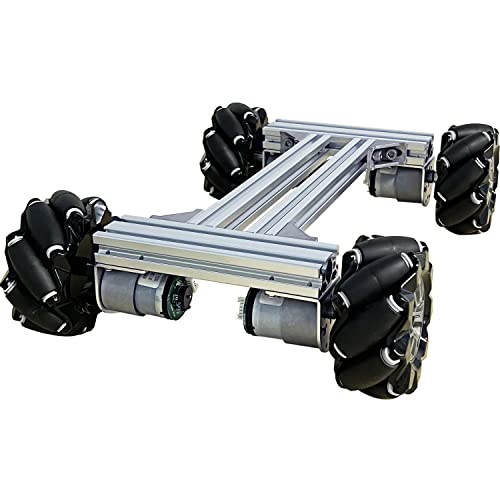
Ideal for robotics enthusiasts and educators, the Mecanum Wheel 4WD Metal Robot Car Chassis Control Learning Kit offers a hands-on approach to understanding robotic mechanics and programming. With compatibility for Arduino, Raspberry Pi, and Microbit, you can easily immerse yourself in DIY STEAM projects. This kit includes a sturdy metal frame, four 97mm mecanum wheels, and four DC encoder motors, all designed for smooth movement and maneuverability. You’ll learn to assemble the robot, grasp its structure, and code movements, making it perfect for educational settings or personal exploration. Just be ready for potential adjustments to enhance performance!
Best For: Robotics enthusiasts and educators looking for a hands-on kit to learn about robotic mechanics and programming.
Pros:
- Robust metal frame and components ensure durability and stability during use.
- Compatible with popular platforms like Arduino, Raspberry Pi, and Microbit, promoting versatility in projects.
- Offers a comprehensive learning experience in assembly, coding, and robotic functionality.
Cons:
- Some users report discrepancies with motors and difficulty in sourcing replacement parts.
- Issues with damaged components upon delivery have been noted by customers.
- May require modifications for optimal performance, which could be a barrier for beginners.
Smart Robot Car Chassis Kit for Arduino/Raspberry Pi
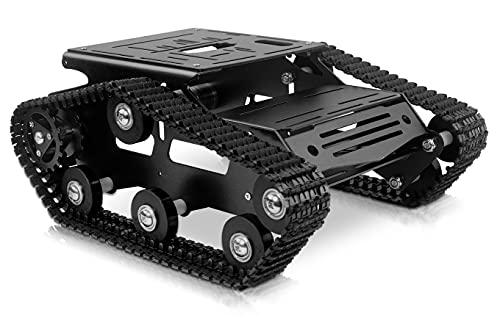
The Smart Robot Car Chassis Kit for Arduino and Raspberry Pi stands out for its robust aluminum alloy design, making it a perfect choice for hobbyists and educators who want to immerse themselves in robotics. This 2WD kit is compatible with Jetson Nano and various Arduino models, allowing you to add sensors and servos easily. Its durable chassis and elastic tracks guarantee agile movement across terrains. While assembly takes about 30-90 minutes and may pose some challenges, detailed instructions help guide you. Overall, it’s a fantastic tool for developing DIY skills and creativity, suitable for ages 12 and up.
Best For: The Smart Robot Car Chassis Kit is best for hobbyists, educators, and anyone interested in robotics and DIY projects aged 12 and up.
Pros:
- Durable aluminum alloy chassis ensures longevity and robustness.
- Compatible with multiple platforms, including Arduino and Raspberry Pi, allowing for easy customization.
- Encourages creativity and hands-on learning, making it ideal for educational settings.
Cons:
- Assembly can be challenging, particularly with wheel and track alignment.
- Some users report issues with tight tracks affecting movement.
- Tools and motor wires received mixed reviews regarding quality.
Waveshare Robotic Arm Kit, Desktop Robot Kit
Product not found or API error.
For hobbyists and educators seeking a versatile platform, the Waveshare Robotic Arm Kit stands out with its high-torque serial bus servo and 360° omnidirectional base. Weighing less than 850g, it features a 4-DOF design and can handle an effective payload of 0.5kg at 0.5m. The onboard ESP32 MCU supports multiple wireless control modes, enhancing your control experience. With a 1-meter diameter workspace and an open-source platform, customization is easy. You’ll find rich tutorials and documentation to help you along the way. While user feedback is generally positive, be cautious of potential safety issues during operation.
Best For: Hobbyists and educators looking for a versatile and customizable robotic platform for projects and learning.
Pros:
- High-torque serial bus servo provides strong lifting power and smooth movements.
- Open-source platform allows for easy customization and compatibility with various systems.
- Rich tutorials and documentation support user-friendly learning and troubleshooting.
Cons:
- Some users report missing parts and issues with customer support response times.
- Safety concerns have been noted, making it unsuitable for young children.
- Documentation quality may not meet everyone’s expectations, leading to potential challenges during setup.
Factors to Consider When Choosing Robot Bases
When choosing a robot base, you need to think about several key factors. Consider the weight and load capacity, as well as the type of wheels and mobility options that will suit your project. Don’t forget to check material durability, assembly complexity, and compatibility with your controllers to guarantee a smooth build process.
Weight and Load Capacity
Choosing the right robot base involves careful consideration of weight and load capacity, as these factors directly impact your project’s success. Start by evaluating the weight of your components and payload, since many bases, like aluminum alloy frames, can support specific loads, such as 1500g. A chassis with a higher load capacity lets you add more sensors and batteries, enhancing functionality. Remember, the material of the chassis affects weight; lightweight aluminum offers strength without excess bulk. Verify the base’s weight aligns with your motors’ capabilities, as exceeding load limits can hinder performance and damage components. Finally, evaluate the overall design and suspension system, as these can influence load capacity and navigation over rough terrain.
Wheel Type and Mobility
Understanding wheel type and mobility is essential for optimizing your robot’s performance in various environments. Mecanum wheels provide 360° omnidirectional movement, perfect for tight spaces and complex navigation. If you prefer straightforward motion, standard wheels are your go-to, while tracked systems enhance traction on rough terrain but may struggle under heavy loads. The diameter and material of your wheels also matter; larger wheels offer better ground clearance and shock absorption, and high-strength plastics improve durability and reduce noise. For robots using differential drive systems, precise wheel control is vital for maneuverability. If you’re venturing off-road, a robust chassis with excellent suspension and shock absorption will help maintain stability and traction on uneven surfaces. Choose wisely to match your project’s needs!
Material Durability and Stability
The performance of your robot base heavily relies on the materials you select, especially after considering how wheel type and mobility affect movement. For durability, opt for aluminum alloy or high-strength plastics; these materials resist deformation and breakage better than lower-quality options. A stable base is essential for balance and precision, so choose materials that guarantee solid weight distribution and structural integrity. Thickness also matters—thicker bases support heavier components and reduce warping risks. Additionally, consider materials with shock absorption features, as they minimize vibrations and enhance accuracy. Finally, select materials that resist moisture, temperature changes, and mechanical stress to guarantee the longevity of your robot base and prevent premature failure.
Compatibility With Controllers
When you’re diving into DIY robot projects, compatibility with controllers like Arduino, Raspberry Pi, or Jetson Nano plays an essential role in guaranteeing your robot functions smoothly. Look for robot bases that specify which microcontrollers they support; this can simplify your integration process. Many bases feature multiple expansion ports, allowing you to add sensors and components, which enhances versatility for various projects. Don’t forget to check the power supply requirements of the robot base to confirm they match your controller’s voltage and current specifications. Finally, review user feedback on compatibility issues to steer clear of potential integration challenges. This way, you can focus on building an efficient and functional robot without unnecessary headaches.
Assembly Complexity and Instructions
Choosing a robot base can feel overwhelming, especially with the varying levels of assembly complexity and the quality of instructions provided. Some kits are designed for straightforward assembly, taking only 30-90 minutes, while others require intricate instructions and extra resources. Most robot chassis kits come unassembled and include step-by-step guides, but the clarity of these instructions can greatly affect your experience. Users often face challenges with component alignment, like wheels and tracks, which can hinder performance. Additionally, some kits lack thorough documentation, causing confusion for beginners. It’s essential to evaluate customer support availability, especially for kits with reported discrepancies. Responsive assistance can make a significant difference in your assembly process and overall project success.
Expansion and Customization Options
Expanding and customizing your robot base can take your DIY project to the next level, making it essential to evaluate these options during your selection process. Look for bases with multiple expansion ports that let you add sensors, servos, and other components to enhance functionality. Verify compatibility with popular microcontrollers like Arduino or Raspberry Pi, as this flexibility allows you to program specific tasks. Open-source chassis designs can further foster creativity, enabling you to modify control codes and communication interfaces. Don’t overlook the importance of user-friendly tutorials and documentation; they can ease assembly and customization for hobbyists and educators alike. Finally, consider bases that support advanced features like GPS and cameras for broader operational capabilities.
Price and Budget Considerations
Evaluating price and budget considerations is key to making the right choice for your robot base. Prices for kits can range from around $30 to over $100, depending on features and complexity. Keep in mind that your budget should also cover extra components like motors, batteries, and controllers, which may not be included. Assess long-term value by checking customer ratings—higher-priced models often deliver better durability and performance, saving you money on repairs. Look for warranty options that protect your investment against defects. Finally, consider the educational value and potential for future expansion; investing a bit more in a versatile base can enhance your learning experience and adaptability for upcoming projects.


