

In 2025, you’ll find seven top relay modules perfect for your DIY electronics projects. Check out the 2PCS 4 Channel 5V Relay Module for safe control of high-voltage devices, or the 6Pcs DC 3.3V Relay Module for 3.3V microcontrollers. The AITRIP 10PCS 5V One Channel Relay Module offers versatility, while the HiLetgo 5V One Channel Relay Module is user-friendly for beginners. Want more options and tips? There’s a wealth of information waiting for you!
2PCS 4 Channel 5V Relay Module for Raspberry Pi and Arduino

If you’re diving into DIY electronics projects with Raspberry Pi or Arduino, the PCS 4 Channel 5V Relay Module is an excellent choice for you. This module features four isolated relay channels, allowing you to control high voltage devices safely. With a maximum load of AC250V at 10A, you can easily switch appliances without worry. The opto-isolator guarantees reliable triggering, while the fault-tolerant design prevents relay movement if the control line fails. Installation’s a breeze, thanks to the screwed terminal plate and fixed bolt holes. Plus, you can customize the input logic with jumper settings for added versatility.
Best For: Hobbyists and developers looking to control high voltage devices safely using Raspberry Pi or Arduino.
Pros:
- Reliable triggering with opto-isolation enhances stability in operations.
- Fault-tolerant design ensures that the relay does not activate if the control line breaks.
- Flexible input logic with jumper settings allows for customization based on project needs.
Cons:
- Limited to 5V operation, which may not be suitable for all applications.
- Requires knowledge of electronics for proper installation and configuration.
- Maximum load limits may restrict usage with certain high-power devices.
6Pcs DC 3.3V Relay Module for Arduino

The 6Pcs DC 3.3V Relay Module is an excellent choice for hobbyists and DIY enthusiasts looking to control high-power devices with their 3.3V microcontrollers, like the ESP32. With a load capacity of 10A at 250VAC and 30VDC, it’s perfect for powering LED lights and small motors. Its dual power supply design enhances reliability, while the fast response time under 20ms guarantees efficient operation. Plus, the convenient crimping terminals make wiring a breeze. Just be cautious about compatibility and potential reliability issues reported by some users. Overall, it’s a compact, effective solution for your electronics projects.
Best For: Hobbyists and DIY enthusiasts looking to control high-power devices with 3.3V microcontrollers.
Pros:
- Compact size and easy installation with fixed mounting holes.
- Dual power supply design enhances anti-interference and reliability.
- Fast response time of less than 20ms ensures efficient operation.
Cons:
- Some users reported reliability issues and failures in multiple modules.
- Compatibility concerns with incorrect tripping voltage for certain setups.
- Confusing documentation and potential security risks associated with product URL.
AITRIP 10PCS 5V One Channel Relay Module Switch for Arduino and Raspberry Pi

For hobbyists and makers looking to expand their DIY electronics projects, the AITRIP 10PCS 5V One Channel Relay Module is an excellent choice. This module is compatible with Arduino, Raspberry Pi, and other platforms, allowing you to control both AC and DC signals, including loads up to 220V. With 10 pieces in the package, you’ll have plenty for various applications, from microcontroller development to home appliance control. The built-in OPTO isolation guarantees safety, while the clear operation indicators make usage straightforward. Rated 4.4 stars by users, it’s a reliable option for your next project.
Best For: Hobbyists and makers looking to enhance their DIY electronics projects with versatile relay control options.
Pros:
- Versatile Compatibility: Works with Arduino, Raspberry Pi, and other platforms for various applications.
- Safety Features: Built-in OPTO isolation and clear operation indicators enhance user safety and ease of use.
- Value Pack: Comes with 10 relay modules, providing ample resources for multiple projects.
Cons:
- Initial Quality Issues: Some users have reported problems with initial modules, requiring replacements.
- Limited Current Rating: Maximum current rating of 4 Amps may not be sufficient for some high-power applications.
- Potential Complexity: May require additional components or knowledge for optimal integration in complex systems.
2PCS 4 Channel 5V Relay Module for Raspberry Pi and Arduino
Designed for hobbyists and professionals alike, the PCS 4 Channel 5V Relay Module offers seamless integration with popular platforms like Raspberry Pi and Arduino. This module features four opto-isolated relays, allowing you to control devices up to AC250V 10A or DC30V 10A effortlessly. Its fault-tolerant design guarantees reliability, preventing relay activation if the control line breaks. Installation is a breeze with screwed terminal plates and fixed bolt holes for mounting. Plus, you can easily select high/low level triggers via a jumper, giving you the flexibility to reverse input logic as needed. It’s a versatile solution for your projects!
Best For: This module is best for hobbyists and professionals looking for a reliable solution to control high voltage devices with microcontrollers like Raspberry Pi and Arduino.
Pros:
- Opto-isolated relays enhance triggering reliability and stability.
- Fault-tolerant design prevents accidental relay activation if the control line fails.
- Easy installation with screwed terminal plates and fixed bolt holes for mounting.
Cons:
- Limited to a maximum load of AC250V 10A, which may not be sufficient for some heavy-duty applications.
- Requires a trigger current of 5mA, which may be a consideration for low-power projects.
- Flexibility in input logic requires manual jumper adjustments, which could be inconvenient for some users.
HiLetgo 5V One Channel Relay Module (2pcs)
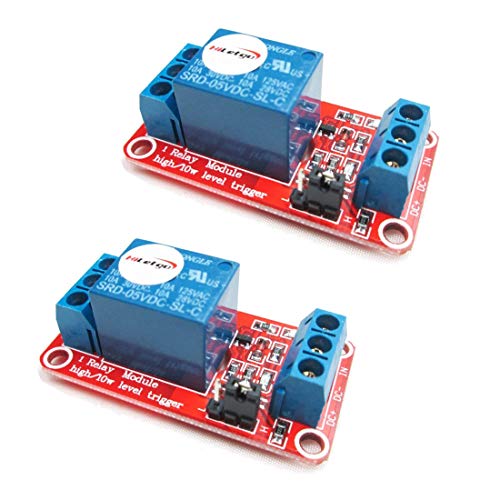
If you’re diving into DIY electronics projects and need reliable control for various devices, the HiLetgo 5V One Channel Relay Module is an excellent choice. This module operates at 5V with a maximum load of AC 250V/10A or DC 30V/10A, making it versatile for many applications. It features opto isolation for stable performance and a fault-tolerant design that prevents unintended operation. Users appreciate the easy wiring with microcontrollers like Arduino and the option to select High or Low Level triggers. With two modules included, you’re set for multiple projects, whether it’s a secret door or remote opening system.
Best For: DIY electronics enthusiasts and hobbyists looking for reliable control solutions for various devices.
Pros:
- Easy to interface with microcontrollers like Arduino, making it beginner-friendly.
- Fault-tolerant design prevents unintended operation, enhancing safety.
- Versatile for multiple applications, including automation projects and remote control systems.
Cons:
- Some users may require specific screwdrivers for installation, which could be inconvenient.
- Limited documentation, including datasheets and diagrams, may hinder usability for some users.
- Preference for solder holes over screw terminals may not suit everyone’s design approach.
4pcs DC 5V Relay Module – 1 Channel Relay Switch Board

The 4pcs DC 5V Relay Module is perfect for hobbyists and professionals looking to control high-power devices with ease. With a working voltage of DC 5V and a maximum load of AC 250V/10A, you can confidently drive various circuits, including lights for e-bikes. Its fault-tolerant design guarantees the relay won’t activate if the control line’s broken. The jumper design allows you to set the state with high or low signals. While some users faced issues with screw terminal quality, many praised its compatibility with platforms like Arduino. Just remember to test it with a 12V wall adapter for peak performance.
Best For: Hobbyists and professionals seeking to control high-power devices effortlessly with a reliable relay module.
Pros:
- High maximum load capacity of AC 250V/10A and DC 30V/10A for versatile applications.
- Fault-tolerant design ensures safety by preventing operation when the control line is broken.
- Compatible with various platforms like Arduino, Raspberry Pi, and CNC machines.
Cons:
- Some users report issues with the quality of screw terminals.
- Inverse logic and jumper settings may cause confusion for some users.
- Documentation could be improved for better user guidance.
ELEGOO 8 Channel DC 5V Relay Module Compatible with Arduino

For hobbyists and DIY enthusiasts looking to expand their projects, the ELEGOO 8 Channel DC 5V Relay Module stands out with its compatibility across various microcontrollers, including Arduino UNO R3 and MEGA 1280. This module operates at 5V and features eight channels, each requiring 70mA to function. You can easily control devices like sprinklers or lights, thanks to its normally open and closed contacts. However, be cautious about using it with 3.3V GPIOs, as this could damage your setup. Verify you connect 5V to VCC for reliable operation, and always monitor relay performance for potential issues.
Best For: Hobbyists and DIY enthusiasts looking for a reliable relay module to control multiple devices in their projects.
Pros:
- Compatible with various microcontrollers, including Arduino, making it versatile for different projects.
- Eight channels allow for control of multiple devices simultaneously, enhancing project functionality.
- Easy setup with clear wiring instructions and status indicators for each relay.
Cons:
- Potential reliability issues reported, with a 40% failure rate observed in initial tests.
- Caution required when using with 3.3V GPIOs, as it may damage the GPIO pads.
- Limited durability for critical applications like life safety systems, requiring careful monitoring.
Factors to Consider When Choosing Relay Modules
When you’re choosing relay modules for your projects, it’s essential to take into account several key factors. You’ll want to check the voltage compatibility, load capacity, and trigger current specifications to guarantee everything works smoothly. Additionally, think about the benefits of optocoupler isolation and how you’ll install and mount the module.
Voltage Compatibility Requirements
Choosing the right relay module for your DIY electronics project hinges on understanding voltage compatibility requirements. Most relay modules operate at standard voltages, like 3.3V or 5V, so you need to match the relay voltage with your microcontroller’s output. Higher voltage ratings, such as AC250V or DC30V, indicate how much load the relay can handle, which is essential for high-power applications. Additionally, pay attention to the trigger voltage; some relays require lower values (0-2V for 5V systems) to activate. For reliable operation, verify the supply voltage aligns with the relay’s specifications. Finally, consider whether your relay requires a high or low level trigger, as this impacts your wiring setup and overall functionality within the circuit.
Load Capacity Considerations
Understanding load capacity is essential for guaranteeing your relay module operates effectively within your DIY electronics project. The load capacity determines the maximum voltage and current the relay can handle, with common ratings like AC250V 10A and DC30V 10A. You must match the relay’s load capacity with the requirements of the devices you’re controlling; exceeding this can cause failure or damage. Relay modules typically specify different AC and DC capacities, so always check these ratings. Some modules may have varying maximum loads for different voltage levels, like 15A at 125VAC and 10A at DC30V. Properly understanding load capacity guarantees safety and reliability, preventing overheating, arcing, or permanent relay damage in your circuit.
Optocoupler Isolation Benefits
Optocoupler isolation greatly enhances the safety and reliability of your relay modules by providing electrical separation between control and load circuits. This separation prevents high voltages from affecting your low-voltage control systems, ensuring a safer operation. Additionally, it improves triggering reliability and stability, as the optocoupler can isolate and amplify weak control signals effectively. With the ability to handle varying input logic levels, you can easily accommodate different microcontroller outputs for high or low-level triggering. Furthermore, using optocouplers contributes to a fault-tolerant design, halting relay operation in case of a control line failure and preventing unintended activation. With typical trigger currents around 5mA, optocouplers offer efficient operation and minimal power consumption when controlling relays.
Trigger Current Specifications
When selecting relay modules, one key aspect to contemplate is the trigger current specification. This specification indicates the minimum current needed to activate the relay, typically ranging from 2mA to 5mA for most modules. A lower trigger current allows you to control the relay with low-power microcontrollers, enhancing compatibility with various devices. If you’re considering relay modules with opto-isolation, be aware that they often have specific trigger currents to guarantee reliable operation and protect your circuit from voltage spikes. It’s essential to match the trigger current to your controlling device’s output capabilities to avoid insufficient activation or potential damage. Some modules even offer jumper settings to configure high or low-level triggering, impacting the required trigger current.
Installation and Mounting Options
Choosing the right installation and mounting options for your relay module can make a significant difference in your project’s success. Most relay modules come with fixed bolt holes or mounting holes, making it easy to attach them securely to various surfaces. Look for modules with screw terminal plates; these simplify wiring connections and guarantee stable electrical contact. Pay attention to the size and layout of the relay module, as dimensions can vary, impacting compatibility with your project. Some modules offer jumper options for high or low-level trigger settings, which can influence your installation choices based on your microcontroller’s control logic. Finally, clear documentation and labeling of input and output connections will help you minimize wiring errors during installation.
Reliability and Durability Factors
While selecting a relay module, it’s important to take into account factors that influence its reliability and durability. Look for fault-tolerant designs that prevent operation if the control line is broken; this guarantees consistent performance. Optocoupler isolation also plays a significant role, providing protection from high voltage spikes and enhancing triggering reliability. Check the specified maximum load capacity—common ratings like AC250V 10A or DC30V 10A indicate the module’s suitability for various applications. Additionally, features like diode freewheeling protection safeguard against back EMF in inductive loads, increasing the relay’s longevity. Finally, don’t underestimate the impact of high-quality soldering and build quality, as user feedback often highlights these as vital to overall durability and lifespan.
Versatility in Applications
Reliability and durability are key factors in selecting relay modules, but their versatility in applications can greatly enhance your DIY projects. These modules can control a variety of devices, from LED lights to small motors and home appliances, making them incredibly adaptable. Many relay modules offer high and low-level trigger selection, ensuring compatibility with various microcontrollers and project needs. Depending on the model, you can handle substantial electrical loads, with some supporting AC loads up to 250V and DC loads up to 30V. Optocoupler isolation adds another layer of versatility, protecting and stabilizing different voltage levels. Plus, their ability to provide circuit isolation makes them perfect for projects that demand safety and reliability in electrical connections.


