

If you’re exploring PWM controllers, the EC Buying DC Motor Speed Controller is an excellent choice for precise motor speed adjustments in various automation projects.
For compact fan control in robotics, consider the Noctua NA-FC1. The RioRand 7-70V 30A is ideal for high-power applications, perfect for AI hardware setups.
If you’re managing multiple fans, the 12V PWM Hub is a must-have. For those needing 3-phase control, the RioRand 300W unit stands out as a reliable option.
Additionally, a PWM-to-voltage module can greatly enhance your industrial automation applications. Stay tuned to discover even more innovative solutions!
EC Buying DC Motor Speed Controller Module

If you’re a tech enthusiast looking to optimize your DC motor’s speed, the EC Buying DC Motor Speed Controller Module stands out as an excellent option. Designed for versatility, it operates within a voltage range of 9V to 60V and can handle a rated current of 12A, peaking at 20A. With a maximum power output of 500W, you can fine-tune the operating frequency from 1KHz to 99KHz. The module includes a digital display for straightforward monitoring of duty cycle and frequency, and it conveniently retains your settings even when powered off. This controller simplifies the process of speed adjustment, making it both efficient and user-friendly.
Best For: Hobbyists and engineers aiming for precise control over DC motor speeds across various technological applications, including automation and robotics.
Pros:
- Adjustable Frequency: Tailor the operating frequency from 1KHz to 99KHz, offering adaptability for different motor types.
- Memory Function: Retains all set parameters when powered off, ensuring ease of use for repeated applications.
- Digital Display: Provides a clear, real-time readout of duty cycle and frequency for effective monitoring.
Cons:
- Limited Protection: The module lacks internal safeguards, making it less suitable for complex electromagnetic environments.
- Current Limitations: Rated for 12A with a maximum of 20A, which may not accommodate larger motors.
- Switch Type: Requires self-reset buttons, which might be less convenient for continuous operation.
Noctua NA-FC1, Compact PWM 4-Pin Manual Fan Speed Controller

The Noctua NA-FC1 is an excellent choice for tech enthusiasts who desire detailed control over their 4-pin PWM fans. This compact controller, measuring just 21 x 25 x 48 mm, seamlessly integrates into your setup. It allows for manual fan speed adjustments while also enabling integration with motherboard controls for enhanced performance. The innovative “No Stop” mode ensures your fans maintain a minimum RPM of 300, effectively preventing annoying BIOS errors. With a 3-way splitter cable, you can efficiently manage up to three fans simultaneously. Plus, backed by a robust six-year warranty, you can trust in its long-lasting reliability for all your cooling requirements.
Best For: Tech enthusiasts looking for precise fan control to optimize cooling performance in their setups.
Pros:
- Manual speed control enables customization of fan performance to meet specific user requirements.
- “No Stop” mode guarantees fans maintain a minimum RPM, avoiding potential BIOS issues.
- Supports multiple fans via a 3-way splitter cable, improving overall cooling efficiency.
Cons:
- Compatibility limited to 4-pin PWM fans, which may not be suitable for all setups.
- Compact design could complicate installation in restrictive spaces.
- Requires manual adjustments, which may not be ideal for users who prefer automated solutions.
RioRand 7-70V 30A PWM DC Motor Speed Controller for Brushed Motors

For technology enthusiasts exploring automation and robotics, the RioRand 7-70V 30A PWM DC Motor Speed Controller stands out as a reliable choice. Operating within a voltage range of 7-70V, this controller offers stepless speed regulation from 1% to 100%, featuring a 12kHz PWM frequency that ensures precise control. Designed with durability in mind, it incorporates high-voltage MOSFETs and an aluminum housing for effective heat dissipation. The clearly marked wiring simplifies setup and safeguards against reverse connections, making it user-friendly. With integrated safety features like overcurrent protection and a spare fuse, this controller is ideal for a variety of applications, including robotics, ventilation systems, and small tools. Experience enhanced performance and control in your projects today!
Best For: Technology enthusiasts and DIYers focused on automation, robotics, and small tool applications.
Pros:
- Sturdy construction with high-voltage MOSFETs and aluminum housing ensures efficient heat management.
- Smooth stepless speed regulation from 1% to 100% for seamless operation.
- Safety features such as overcurrent protection and a spare fuse boost reliability.
Cons:
- Limited power output at lower voltages may not meet the demands of some high-performance applications.
- A PWM frequency of 12kHz might not be optimal for all motor types.
- Requires careful wiring to avoid damage from reverse connections.
12V PWM Fan Speed Controller Hub for 6 Fans

Looking for an efficient way to manage multiple fans in your tech setup? The 12V 4 Pin PWM Fan Speed Controller Hub from OwlTree is your ideal solution. This hub supports up to six 4-pin PWM fans, ensuring optimal cooling for your system. With flexible power input options, including Type-C and DC 5.5×2.1mm, you’ll enjoy enhanced versatility. Adjust the PWM duty cycle easily through ten indicator lights, providing real-time visibility of fan performance. Just a note: it’s not compatible with 3-pin or 2-pin fans. For tech enthusiasts and professionals looking for reliable fan control, this hub is a must-have addition to your setup.
Best For: Tech enthusiasts and professionals looking to efficiently manage multiple 4-pin PWM fans for optimal cooling performance in automation, robotics, and AI applications.
Pros:
- Supports up to 6 fans: Enables extensive cooling options for larger systems or advanced tech setups.
- Flexible power input: Compatible with both Type-C and DC 5.5×2.1mm power sources for added convenience.
- Real-time duty cycle adjustment: Ten indicator lights offer clear visibility of fan performance.
Cons:
- Limited fan compatibility: Designed exclusively for 4-pin PWM fans, excluding 3-pin and 2-pin options.
- Power limitations: Each port supports a maximum of 2A, with a total current limit of 5A.
- No fans included: The hub is sold separately from the fans, necessitating additional purchases.
RioRand 300W 3-Phase PWM DC Motor Speed Controller
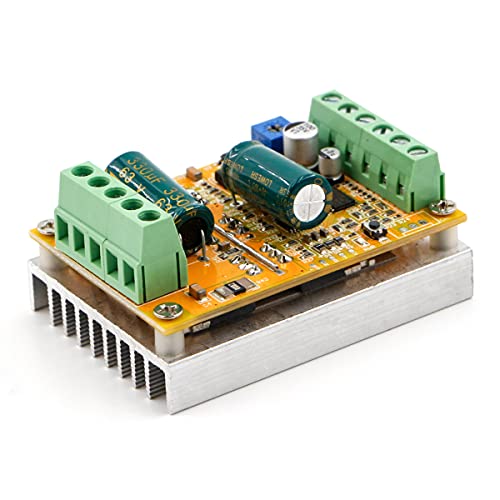
If you’re a technology enthusiast exploring automation or robotics, the RioRand 300W 3-Phase PWM DC Motor Speed Controller is an excellent choice for precise control over your brushless motors. With a robust power output of 300W and compatibility with Hall-free motors, this compact unit is well-suited for a variety of projects in both hobbyist and professional settings. It operates within a flexible voltage range of 5-50V, making it adaptable for different applications.
The user-friendly design features durable terminal blocks and an onboard speed potentiometer, ensuring ease of installation and operation. Quick response acceleration and braking enhance safety, while built-in protection mechanisms protect against overcurrent and overheating. This makes it an essential tool for anyone looking to optimize motor performance in their automation or robotics projects.
Best For: Hobbyists, engineers, and tech enthusiasts seeking precise control and flexibility in operating brushless DC motors.
Pros:
- User-friendly design with durable terminal blocks for straightforward wiring and installation.
- Quick response acceleration and braking improve safety during operation.
- Built-in protection mechanisms safeguard against overcurrent and overheating.
Cons:
- Limited to Hall-free motors, which may restrict compatibility for certain applications.
- Requires careful initial setup at low voltage and current to prevent damage.
- Peak power output may not suffice for high-demand applications exceeding 300W.
PWM to Voltage Module 0-10V for Industrial Control

The PWM to Voltage Module 0-10V is a must-have for technology enthusiasts engaged in automation, robotics, and AI advancements. This compact module efficiently converts a 0-100% PWM digital signal at 3.3V into a 0-10V analog signal, making it ideal for use with PLCs and microcontrollers. Operating within a voltage range of 15-30V DC and accommodating a PWM frequency range of 1-3kHz, it integrates effortlessly into a variety of applications across different tech domains. The inclusion of embedded microcontroller technology simplifies operation, while the fine-tuning potentiometer allows for precise adjustments. Additionally, a jump pin for 5V insertion enhances compatibility for diverse setups. This module significantly boosts your capabilities in industrial control and beyond.
Best For: Technology enthusiasts exploring reliable solutions for converting PWM signals into analog voltage across automation, robotics, and AI projects.
Pros:
- Versatile Output: Converts 0-100% PWM signals into a stable 0-10V analog output.
- User-Friendly: Equipped with an embedded microcontroller and fine-tuning potentiometer for straightforward adjustments.
- Compact Design: Ideal for integration into various applications and existing systems.
Cons:
- Power Supply Requirement: Requires a working voltage of 15-30V DC, which may limit its use in certain scenarios.
- Frequency Limitations: The recommended PWM frequency range of 1-3kHz might not suit all signal types.
- Potential Complexity: Optimal configuration and integration may necessitate additional knowledge.
Power Electronic Converters: PWM Strategies and Current Control Techniques

PWM Controllers for Enthusiasts is perfect for engineers and hobbyists eager to master PWM strategies in power electronic converters. This comprehensive resource delves into essential current control techniques, enabling you to optimize performance across various technologies. With detailed illustrations and practical examples, you’ll gain a deep understanding of PWM modulation and its applications, not just in power electronics but also in automation, robotics, and AI advancements. Learn how to enhance efficiency and stability while minimizing disturbances in your projects. Published by Wiley-ISTE, this hardcover book is a must-have for anyone serious about advancing their knowledge in technology.
Best For: Engineers and hobbyists keen to explore PWM strategies and current control techniques, with insights applicable across various technological fields.
Pros:
- Comprehensive coverage of PWM strategies and current control techniques, suitable for both beginners and advanced users.
- Illustrated content enhances understanding of complex concepts through visual aids and practical examples.
- Focus on efficiency and stability, providing strategies to minimize disturbances in electronic designs.
Cons:
- Heavy technical jargon may pose challenges for complete beginners without a background in power electronics.
- Lengthy format (608 pages) could be overwhelming for casual readers or those seeking quick references.
- Limited focus on real-world applications may not fully address every practical scenario encountered in diverse technological settings.
Factors to Consider When Choosing PWM Controllers
When selecting a PWM controller, several crucial factors can shape your decision, especially in the realms of automation, robotics, and AI advancements. Consider the compatibility with the required voltage range, the current handling capacity for your application, and the types of control signals you intend to implement. Furthermore, the ability to adjust PWM frequency is vital for optimizing performance in specific technological applications, ensuring efficiency and precision in automated systems.
Factors Affecting PWM Controllers
Choosing the right PWM controller is crucial for optimizing performance and efficiency across various technology projects, including automation, robotics, and AI applications. First, ensure the controller supports the necessary voltage range for your specific application, such as 9V to 60V. Next, consider the current rating; different controllers handle various capacities, like 12A or 30A, which affects their compatibility with motors and fans used in robotic systems or automated machinery.
Don’t overlook the operating frequency; a range from 1 kHz to 99 kHz can significantly influence overall performance, especially in applications requiring rapid response times. Fine duty cycle control—from 0-100%—is also essential for precise speed regulation, vital in both robotics and automation tasks. Lastly, assess the protection features, such as overcurrent and over-temperature safeguards, to prevent damage and ensure reliability in your projects. By carefully evaluating these factors, you’ll select a PWM controller that aligns with your specific technological needs and ensures superior operation in your applications.
Voltage Range Compatibility
Selecting the right voltage range for your automation or robotics application is crucial for optimal performance and to prevent potential damage. When choosing a PWM controller, ensure that the voltage range aligns with your specific requirements—controllers typically operate within defined limits, such as 9V to 60V or 7V to 70V. It’s essential to consider the maximum voltage tolerance; exceeding this limit can result in failure. Verify that the controller supports the operational voltage of your motor or fan, as insufficient voltage can compromise efficiency. Different PWM controllers may have varying acceptable input ranges, so check for compatibility with your existing system. Additionally, keep in mind that higher voltage ratings often correlate with greater power handling capabilities, such as 300W at 5-50V, making it vital to choose wisely for your technology projects.
Current Handling Capacity
After confirming that your PWM controller meets the required voltage range, it’s essential to examine its current handling capacity. This factor is crucial, as it dictates how much load your controller can manage safely without overheating or incurring damage. Look for the rated current, typically measured in amps (A), which signifies the continuous current it can support. Ensure that this rating exceeds your anticipated load to prevent failures. Additionally, consider the power output capability in watts (W), which is calculated by multiplying the voltage by the rated current. Don’t overlook the importance of overcurrent protection mechanisms, such as fuses or circuit breakers, which protect against surges. Prioritizing a controller with the appropriate current capacity is key to ensuring reliable performance, especially in applications related to automation, robotics, and AI advancements.
Control Signal Types
When exploring PWM controllers, it’s crucial to understand the various control signals they accept, as this can significantly influence your project’s success in automation, robotics, and AI advancements. PWM controllers typically accept a range of signal types, including analog voltage signals (0-5V or 0-10V) and digital PWM signals (3.3V or 5V). This adaptability facilitates seamless integration with diverse systems. The frequency range of the PWM signal, usually between 100Hz to 3kHz, also plays a vital role in determining how responsive your motor or device will be. Additionally, some controllers support multiple input types, such as PLC control and Hall throttle inputs, which enhances their versatility. Keep in mind that the duty cycle directly affects the power delivered to your motor, enabling precise speed regulation that is essential for optimal performance in various technological applications.
PWM Frequency Adjustment
PWM Frequency Adjustment for Enhanced Performance in Technology Applications
Adjusting PWM frequency is crucial for optimizing motor performance and efficiency across various technological fields, including automation and robotics. Frequencies typically range from 1 kHz to 99 kHz, enabling fine-tuning of motor speed to meet specific application demands. Higher frequencies can lead to smoother operation, but they may also produce excess heat, requiring effective heat dissipation strategies. Conversely, in applications involving sensitive electronics, lower frequencies can minimize electromagnetic interference, thereby improving signal integrity. It’s important to remember that the duty cycle works in conjunction with frequency, determining the effective power delivered to the load. Selecting a frequency that aligns with your motor’s operational characteristics is vital for achieving optimal performance and efficiency in diverse technology domains.
Heat Management Features
Effective heat management features are crucial for ensuring the reliability and longevity of PWM controllers, particularly in high-performance applications related to automation, robotics, and AI advancements. When selecting controllers, prioritize those that utilize aluminum heat-dissipating housings and high-voltage MOSFETs, as these materials effectively minimize heat buildup. Design elements that reduce vibration noise can further enhance overall performance under load, which is vital in robotics and automation systems.
It’s also important to choose controllers equipped with overcurrent protection mechanisms to prevent excessive heat generation during surges, safeguarding against potential component failure. Consider models that include onboard heat sinks to boost cooling efficiency, enabling continuous operation at higher power outputs without compromising performance.
Lastly, regular temperature monitoring and proper ventilation are essential for maintaining the lifespan and reliability of your PWM controller, especially in demanding technological environments.
User Interface Design
Reliable heat management features in PWM controllers are crucial for effective user interface design, especially in the realms of automation, robotics, and AI advancements. A clear and intuitive display is essential, emphasizing critical parameters like duty cycle and frequency to facilitate easy understanding and control. A responsive digital encoder knob enables precise adjustments, with short and long press functions simplifying ON/OFF toggling and parameter settings.
Moreover, an easily navigable interface allows users to swiftly select limits and operating conditions, enhancing usability across various technological applications. Visual indicators, such as LED lights, provide immediate feedback on motor status and input voltage levels, which is invaluable for troubleshooting in complex systems. Lastly, a compact design with well-marked wiring connections ensures straightforward installation, minimizing user errors during setup and operation, which is vital in any tech-driven environment.
Protection Mechanisms Available
When selecting PWM controllers, it’s crucial to prioritize protection mechanisms to ensure your system operates safely and efficiently within various technological domains, including automation, robotics, and AI advancements. Effective PWM controllers often feature overcurrent protection, which prevents damage from current surges and enhances reliability across applications. Look for locked-rotor protection, as it automatically reduces current if the motor stalls, helping to avoid burnout—a key consideration in robotic systems. Over-temperature protection is essential as well; it reduces power output when overheating is detected, safeguarding your device from thermal damage in automated environments. Some controllers even incorporate built-in fuses that act as a fail-safe against excessive current, adding an extra layer of security for sensitive components. Finally, quick response acceleration and braking capabilities help prevent high inrush currents, contributing to smoother operation and enhanced safety for your entire technological setup.


