
When you’re searching for the best magnetometers in 2025, consider options like the 8103 Gauss Meter and the Gauss/Tesla Meter with High Precision Probe for reliable magnetic field testing. The GY-271 Triple Axis Compass Sensor and Waveshare BMM150 are excellent for hobbyists and drone projects. Don’t overlook the EMF Meter 600S for thorough radiation detection. Each device brings unique features to suit your needs, and there’s plenty more to explore to find your perfect match.
8103 Gauss Meter, Rechargeable Tesla Meter

If you’re an engineer or technician looking for a reliable tool to measure magnetic fields, the 8103 Gauss Meter, Rechargeable Tesla Meter is an excellent choice. It measures magnetic field strength from 0-2500 mT with ±5% accuracy, making it perfect for various applications, including DC magnetic field measurement and equipment repair. You’ll appreciate its dual modes for quality control and motor testing. With a built-in 750mAh rechargeable battery, the device offers up to 16 hours of use. The compact design features a TFT color display and comes with essential accessories, ensuring you have everything you need for precise magnetic analysis.
Best For: Engineers and technicians needing a reliable and accurate tool for measuring magnetic fields in various applications.
Pros:
- Accurate measurements with a range of 0-2500 mT and ±5% accuracy suitable for quality control and troubleshooting.
- Long battery life with a built-in 750mAh rechargeable battery providing up to 16 hours of continuous use.
- User-friendly design featuring a TFT color display, hands-free operation stand, and essential accessories for convenience.
Cons:
- Probe vulnerability may pose concerns during frequent use or in rugged environments.
- Stability of the stand could be improved for better hands-free operation.
- Minor learning curve for new users unfamiliar with magnetic measurement tools.
Gauss/Tesla Meter with High Precision Probe for Magnetic Field Testing
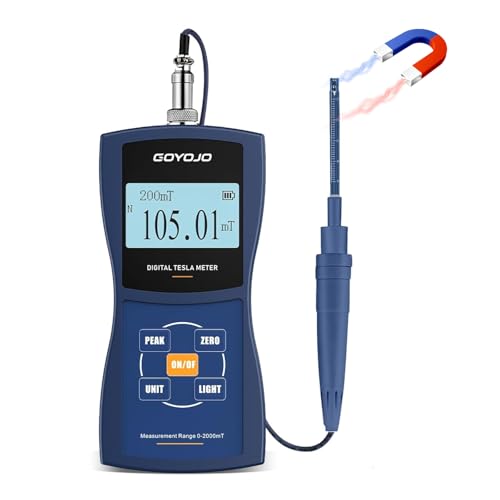
The Gauss/Tesla Meter with High Precision Probe is the ideal choice for professionals and enthusiasts who require accurate measurements of magnetic fields in various applications. It measures magnetic fields up to 2000mT (20000Gs) with impressive accuracy levels and auto range switching for convenience. The user-friendly design includes features like one-key zeroing and a backlit display, making it easy to use in the field or lab. You’ll appreciate its portability and lightweight build. Plus, it’s perfect for calibration, safety assessments, and educational purposes. With lifetime technical support, you can trust it’s a reliable tool for your magnetic field testing needs.
Best For: Professionals and enthusiasts seeking precise magnetic field measurements for calibration, safety assessments, and educational purposes.
Pros:
- User-friendly features such as one-key zeroing and a backlit display enhance usability in various environments.
- Lightweight and portable design makes it suitable for both fieldwork and laboratory use.
- Includes lifetime technical support and a calibration certificate, ensuring reliability and accuracy.
Cons:
- The threshold for readings may limit visibility of low field measurements, as it only displays values above 2 gauss (0.2mT).
- Different Hall probes require careful handling to avoid damage, potentially affecting usability in some cases.
- Accuracy decreases for measurements above 1000mT, with a basic error margin of ±5%.
8103 Gauss Meter, Rechargeable Tesla Meter
Engineers and technicians seeking precision in magnetic field measurement will find the 8103 Gauss Meter, Rechargeable Tesla Meter, an essential tool. With a measurement range of 0-2500 mT and ±5% accuracy, it’s perfect for detecting magnetic field strength and identifying pole directions. Its user-friendly design includes a TFT color display, built-in 750mAh rechargeable battery, and dual modes for various applications. Alarms alert you when thresholds are exceeded, while data storage features guarantee you keep track of important values. Compact and robust, this meter is ideal for quality control and certification processes in diverse settings.
Best For: Engineers and technicians needing precise magnetic field measurements for quality control and certification processes.
Pros:
- User-friendly design with a clear TFT color display for easy reading.
- Dual modes allow for versatile applications, including QC testing and motor diagnostics.
- Long-lasting rechargeable battery supports up to 16 hours of continuous use.
Cons:
- Some users report concerns about the vulnerability of the probe.
- The stability of the stand may not be sufficient for all testing scenarios.
- Limited accuracy of ±5% may not meet the needs of extremely precise measurements.
8103 Gauss Meter, Rechargeable Tesla Meter
For professionals in industrial settings or research labs, the 8103 Gauss Meter stands out as an essential tool for precise magnetic field measurements. With a measurement range of 0-2500 mT, it accurately detects magnetic field strength and pole direction. Its user-friendly design features a rechargeable battery that lasts up to 16 hours and a clear TFT display. You’ll appreciate its audible alarms and data hold functions for tracking maximum values. Despite minor critiques about probe durability, this Gauss Meter excels in both industrial and educational applications, making it a reliable choice for anyone needing accurate magnetic assessments.
Best For: Professionals in industrial settings and research labs who require precise and reliable magnetic field measurements.
Pros:
- User-friendly design with a clear TFT display and intuitive interface.
- Long-lasting rechargeable battery providing up to 16 hours of continuous use.
- Dual modes for various applications, including QC testing and motor maintenance.
Cons:
- Probe durability has been noted as a concern by some users.
- Desire for a longer testing cable for greater flexibility during measurements.
- A few users have reported accuracy issues in specific applications, suggesting caution in those cases.
3Pcs GY-271 Triple Axis Compass Magnetometer Sensor Module

Offering a versatile solution for hobbyists and developers, the GY-271 Triple Axis Compass Magnetometer Sensor Module excels in applications requiring precise magnetic field measurements. With its QMC5883L sensor, it supports magnetic field ranges of ±1.3 to 8.1 gauss and acceleration ranges of ±2 g to 8 g, making it adaptable for various projects. The compact design and high-quality construction guarantee durability. However, be cautious of reported issues, such as incorrect I2C addresses and defective units. While many users appreciate its performance, some recommend exploring alternative suppliers if you encounter problems. Overall, it’s a solid choice for your Arduino projects.
Best For: Hobbyists and developers looking for an affordable and versatile sensor for magnetic field measurements in Arduino projects.
Pros:
- High-quality construction with durable materials ensuring longevity.
- Supports a wide range of magnetic field and acceleration measurements for diverse applications.
- Compact design, ideal for projects with limited space.
Cons:
- Reports of units returning incorrect I2C addresses and static data for axis readings.
- Some users have experienced defective units, limiting functionality to only the x-axis.
- Mixed customer feedback regarding reliability, prompting caution when purchasing.
Waveshare BMM150 3-axis Magnetometer Sensor

The Waveshare BMM150 3-axis Magnetometer Sensor stands out as an ideal choice for hobbyists and developers working on projects like robot navigation, drones, or wearable technology. Its ultra-small design and low power consumption make it perfect for compact applications. Operating at 3.3V or 5V, it communicates via I2C or SPI, ensuring versatility. With a measuring range of ±1300μT for the x and y axes and ±2500μT for the z-axis, you’ll get accurate readings. Users appreciate its accuracy and ease of integration, although some mention minor concerns with direction accuracy. Overall, it’s a reliable option for your magnetometer needs.
Best For: Hobbyists and developers looking for a compact and efficient magnetometer for projects like robot navigation, drones, and wearables.
Pros:
- Compact design allows for integration into small devices.
- Low power consumption makes it suitable for battery-operated applications.
- Versatile communication options (I2C/SPI) enhance compatibility with various platforms.
Cons:
- Some users report minor accuracy issues with compass direction.
- Dependency on external libraries for software integration may complicate setup.
- Limited data output rate of 10Hz may not meet the needs of high-speed applications.
EMF Meter Digital Electromagnetic Field Radiation Detector (600S)

Designed for both personal and professional use, the EMF Meter Digital Electromagnetic Field Radiation Detector (600S) is perfect for anyone looking to monitor electromagnetic fields in their environment. This compact, hand-held device features a thorough 3-in-1 detection system, measuring AC Magnetic Fields, AC Electric Fields, and RF/Microwave Radiation. It’s USB rechargeable and operates with a single button, making it user-friendly. Color-coded LED alerts provide instant feedback on radiation levels, while the large backlit display guarantees you can read EF, MF, and RF levels easily, even in low light. Whether at home, in the office, or outdoors, stay informed and safe.
Best For: Individuals and professionals seeking to assess and monitor electromagnetic field radiation levels in various environments, including homes, offices, and outdoor settings.
Pros:
- Comprehensive 3-in-1 detection for AC Magnetic Fields, AC Electric Fields, and RF/Microwave Radiation.
- User-friendly design with USB rechargeable battery and single-button operation for easy use.
- Instant visual alerts with color-coded LED bar graph for quick identification of radiation levels.
Cons:
- May require regular charging, which can be inconvenient for some users.
- Limited functionality in measuring extremely high-frequency radiation beyond standard ranges.
- The compact size may make it easy to misplace if not stored properly.
Factors to Consider When Choosing Magnetometers
When you’re choosing a magnetometer, think about the measurement range and how accurate you need your readings to be. Consider the portability and design features that fit your specific applications, along with how user-friendly the interface is. Each of these factors will play a key role in ensuring you get the right tool for your needs.
Measurement Range Considerations
Selecting the right magnetometer hinges on understanding measurement range considerations, as it directly influences the device’s ability to detect varying magnetic field strengths accurately. It’s essential to take into account the measurement range, which determines the maximum magnetic field strength the device can handle. Common ranges go from 0 to 2500 mT for general applications. A wider range offers versatility, allowing you to detect both weak and strong magnetic fields without saturation. If you choose a device with a lower range, like up to 200 mT, it may struggle in high magnetic environments. Think about your specific needs, whether measuring residual magnetism or conducting quality control tests, to guarantee you select a magnetometer with an appropriate measurement range for your application.
Accuracy and Calibration Needs
Accuracy and calibration needs play a crucial role in choosing the right magnetometer for your applications. You should focus on the precision levels, which typically range from ±2% to ±5%, depending on the model. Calibration is essential for maintaining this accuracy, so look for devices that offer both manual and automatic zero calibration options. It’s also important to take into account the measurement range, as some devices can measure up to 2500 mT or more, influencing their suitability for your specific tasks. Regular calibration checks are necessary, especially in industrial settings, to comply with quality control standards. Additionally, evaluate the magnetic field sensitivity and polarity identification features for enhanced measurement accuracy in your particular applications.
Portability and Design Features
Choosing the right magnetometer goes beyond just accuracy and calibration; portability and design features are key factors that can greatly impact your experience. Lightweight designs are essential, especially for fieldwork or lab settings, making it easier to carry and use your device. Look for models with rechargeable batteries that provide up to 16 hours of usage, minimizing downtime during extended projects. User-friendly features like compact layouts and intuitive interfaces enhance usability. A stand for hands-free operation is invaluable, allowing you to take measurements without constant manual handling. Finally, verify the magnetometer is built durably, with solid construction and protective cases, so it can withstand diverse environments and maintain reliability over time.
Application Suitability
When it comes to finding the right magnetometer for your needs, understanding application suitability is crucial. Different models cater to specific tasks; for example, some excel in detecting magnetic fields from permanent magnets, while others focus on environmental safety assessments. Pay attention to the measurement range—some magnetometers offer up to 2500 mT, affecting their effectiveness in various settings. Accuracy is important too; basic errors can range from ±2% to ±5%, impacting reliability. Additional features like polarity identification and auto range switching enhance versatility for applications such as quality control and educational experiments. Finally, consider portability and ease of use, as some designs are lightweight and battery-operated for field use, while others suit stationary laboratory settings.
User Interface and Usability
A user-friendly interface can make all the difference in your experience with magnetometers, ensuring you get accurate readings without hassle. Look for intuitive controls that allow for quick operations, like one-key zeroing and maximum value hold. Clear, backlit displays enhance visibility, so you can read data easily in various lighting conditions, essential for fieldwork. Features like audible and visual alarms provide immediate feedback when measurements exceed set thresholds, simplifying monitoring. Compact and lightweight designs boost portability, making it easy to carry your magnetometer wherever you go. Additionally, multiple data output options and communication interfaces, such as I2C or SPI, enhance usability for developers, allowing seamless integration into different systems and projects.


