

For 2025, you’ve got some fantastic options for load cells that promise precision and reliability. The S Type Load Cell and Mini Load Cell are great for different capacities, while the ShangHJ Digital Load Cell Kit is perfect for DIY projects. For industrial use, check out the Load Cell Sensor with Indicator Display and ATO’s high-capacity model. Each offers unique features to meet your needs. Stick around to uncover more details on these top choices.
S Type Load Cell Weighing Sensor with Indicator Display for Scale (0-200KG)

If you’re looking for a reliable and precise weighing solution, the S Type Load Cell Weighing Sensor with Indicator Display for Scale (0-200KG) stands out as the best choice in 2025. This sensor guarantees high precision with an accuracy of 0.2% for static and dynamic weighing. Its dual relay output enhances automation, allowing you to set weight thresholds for control or data recording. You’ll appreciate the user-friendly interface, featuring four display units and real-time updates. Designed for easy installation, its durable rings improve safety and efficiency. Whether for testing or standard weighing, this load cell meets diverse needs effectively.
Best For: The S Type Load Cell Weighing Sensor is best for industrial applications requiring accurate weight measurement and automation, such as material testing and lifting operations.
Pros:
- High precision measurement with an accuracy of 0.2% for both static and dynamic weighing.
- Dual relay output allows for automated control and data recording based on weight thresholds.
- User-friendly interface with a high-definition display and four switchable measurement units.
Cons:
- Limited weight capacity options may not meet the needs of heavier applications (max 200KG).
- Installation may require additional hardware or expertise for optimal setup.
- The reliance on electronic components may introduce potential failure points over time.
Mini Load Cell Force Weight Sensor (0-10KG)

The Mini Load Cell Force Weight Sensor (0-10KG) stands out as an excellent choice for hobbyists and professionals alike who need precise measurements in weight and force applications. With an accuracy of 0.2%, this stainless steel sensor excels in both tension and compression testing. Its optimized design and high-quality materials guarantee durability and stability in various environments. Thanks to built-in anti-interference features, you can trust its accuracy despite external factors. Plus, a 3-meter cable makes setup easy. With low maintenance costs and reliable performance, it’s perfect for both casual projects and demanding tasks.
Best For: Hobbyists and professionals seeking precise weight and force measurements in their projects.
Pros:
- High accuracy of 0.2% ensures reliable measurement data for various applications.
- Durable stainless steel construction enhances stability and longevity in different environments.
- Easy setup with a 3-meter cable and low maintenance costs make it user-friendly.
Cons:
- Limited capacity of 10KG may not be sufficient for heavy-duty applications.
- Requires careful handling to maintain accuracy and prevent damage.
- Some users may find the setup instructions lacking in detail.
ShangHJ Digital Load Cell Weight Sensor Kit for Arduino

Looking for a reliable and easy-to-use load cell kit? The ShangHJ Digital Load Cell Weight Sensor Kit for Arduino is perfect for your DIY projects. With a maximum load capacity of 5kg, it’s ideal for creating portable electronic kitchen scales. This kit includes four load cells and HX711 ADC modules, featuring a 24-bit A/D converter for high precision. Installation is straightforward, but be careful not to press the white rubber part. Users appreciate its ease of use and consistent results, making it a fantastic choice for hobbyists and developers alike. Get started with your next project today!
Best For: Hobbyists and developers looking to create DIY electronic kitchen scales or weight measuring devices.
Pros:
- Easy installation with a user-friendly design.
- High precision with a 24-bit A/D converter for accurate measurements.
- Compatible with Arduino and Raspberry Pi, making it versatile for various projects.
Cons:
- Some users may find the lack of directional arrows on load cells confusing.
- Requires prior knowledge for effective use, which may not be suitable for beginners.
- Care must be taken to avoid damaging the sensor by pressing the white rubber part.
4pcs Load Cell Half Bridge Strain Gauge Weight Sensor + HX711 Amplifier AD Module for Arduino

Engineers and hobbyists seeking an affordable and versatile weight sensing solution will find the 4pcs Load Cell Half Bridge Strain Gauge Weight Sensor paired with the HX711 Amplifier AD Module for Arduino an excellent choice. This kit includes four 50kg load cells, allowing you to configure for up to 200kg by combining sensors. Users report easy integration with systems like Home Assistant, achieving +/-1g accuracy. While the tiny wires can be tricky, using Dupont jumper wires simplifies connections. Just remember to short resistor 8 on the HX711 board for accurate readings, ensuring you get the most reliable performance for your projects.
Best For: Engineers and hobbyists looking for an affordable and versatile weight sensing solution for their projects.
Pros:
- Easy integration with systems like Home Assistant for seamless weight monitoring.
- Achieves +/-1g accuracy with a maximum load capacity of 200kg, making it suitable for various applications.
- Cost-effective solution with four sensors included, allowing for multiple configuration options.
Cons:
- Tiny wires may pose challenges during setup, requiring careful handling or additional wiring solutions.
- Requires shorting resistor 8 on the HX711 board for optimal performance, which may be overlooked by some users.
- Potential voltage delta issues with HX711 boards can lead to scale value drift if not properly configured.
Load Cell Sensor with Indicator Display (0-5T)
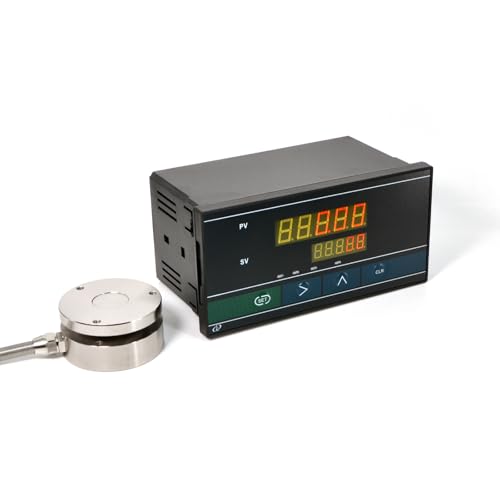
For those seeking a reliable solution in industrial weighing, the Load Cell Sensor with Indicator Display (0-5T) stands out due to its high-precision bellows structure. This sensor offers excellent anti-biased load ability and long-term stability, making it ideal for various applications. With a high-brightness LED display, you can easily read weight data at a glance. The Peak Hold function automatically captures maximum weight values, perfect for data analysis. Plus, its two sets of programmable relay outputs let you control external devices or alarms. You can also switch between units like kilograms, pounds, and tons to suit your needs.
Best For: Industrial professionals and businesses seeking accurate and reliable weighing solutions for various applications.
Pros:
- High-precision bellows structure ensures excellent anti-biased load ability and long-term stability.
- Clear and intuitive five-digit LED display for easy weight reading.
- Peak Hold function allows for efficient recording and analysis of maximum weight values.
Cons:
- Limited to a maximum weight capacity of 5 tons, which may not be suitable for heavier applications.
- Programmable relay outputs may require additional setup and configuration for optimal use.
- Dependence on external power supply could limit portability and flexibility in some working environments.
2 Sets Digital Load Cell Weight Sensor with HX711 ADC Module
Product not found or API error.
The Sets Digital Load Cell Weight Sensor with HX711 ADC Module is an excellent choice for DIY enthusiasts and developers seeking a reliable solution for creating portable electronic scales. This kit includes two load cells, each capable of measuring up to 5kg. With four leads for easy connections, it operates on a 5-10V drive voltage. The HX711 module features a 24-bit A/D converter, ensuring high precision and simple digital control. Users appreciate its compatibility with Arduino and Raspberry Pi. Just remember to avoid direct pressure on the load cell’s rubber part to prevent damage during your projects.
Best For: DIY enthusiasts and developers looking to create accurate and portable electronic scales.
Pros:
- High precision with a 24-bit A/D converter for accurate weight measurements.
- Easy to connect with four leads and compatibility with Arduino and Raspberry Pi.
- Lightweight and compact design, perfect for portable applications.
Cons:
- Limited to a maximum weight of 5kg, which may not suit all applications.
- Users have reported issues with the selectable output data rate being fixed at 10Hz.
- Care must be taken to avoid damaging the load cell’s rubber part and ensure wire thickness is appropriate.
ATO Tension and Compression Load Cell (2000kg)

With a robust capacity of 2000kg, the ATO Tension and Compression Load Cell stands out as an ideal choice for professionals seeking precision in low-profile applications. Its high-precision strain gauge guarantees accuracy of 0.05% F.S, making it perfect for platform scales, truck scales, and rail weighbridges. Designed with a low-profile pancake shape, it offers excellent strength and symmetry while maintaining anti-eccentric load performance. With an IP67 protection class, it’s built to withstand various environments. If you have questions or need assistance, ATO’s customer-first approach assures a response within 12 hours, guaranteeing you get the support you need.
Best For: Professionals in need of a high-precision load measurement solution for low-profile applications such as platform scales, truck scales, and rail weighbridges.
Pros:
- High accuracy of 0.05% F.S, ensuring reliable measurements.
- Low-profile pancake design allows for easy integration into tight spaces.
- IP67 protection class makes it suitable for harsh environments.
Cons:
- Capacity limited to 2000kg, which may not meet the needs for heavier applications.
- Requires careful installation to maintain anti-eccentric load performance.
- Sensitivity may vary slightly within the specified range (2.0±0.1mV/V), which could affect calibration.
Factors to Consider When Choosing Load Cells
When choosing load cells, you need to contemplate key factors that affect performance. Measurement precision, load capacity, and environmental resistance are just a few elements that can impact your decision. Make sure to evaluate these aspects to find the best fit for your specific application.
Measurement Precision and Accuracy
How can you guarantee that your load cell provides the most reliable data? First, look for models with measurement precision levels as low as 0.2%. This confirms accurate readings for both static and dynamic applications. The choice of sensing elements and signal processing technology is vital; advanced designs help minimize drift and enhance stability over time. Make certain the load cell’s specified capacity range matches your application, whether it’s 0-10kg or up to 2000kg. Don’t forget environmental factors—temperature changes and electromagnetic interference can impact precision. Opt for sensors with anti-interference features. Finally, regular calibration and proper installation are essential to maintain accuracy and guarantee long-term reliability in various applications.
Load Capacity Requirements
Choosing the right load cell involves understanding load capacity requirements, as this factor directly influences the sensor’s ability to measure weight accurately without damage. Load cells come in various capacities, from 0-10kg for lightweight tasks to over 2000kg for heavy-duty applications. It’s essential to select a load cell with a capacity exceeding your maximum expected load, ideally with a safety margin of 20-30%. Remember, measurement accuracy can differ across load capacities, and higher capacity load cells might show reduced precision. If you need dynamic measurements, confirm the load cell can handle both static and dynamic forces during operation. By considering these factors, you’ll make a more informed choice tailored to your specific needs.
Output and Automation Features
After determining load capacity requirements, it’s time to evaluate output and automation features that enhance the functionality of load cells. Load cells with dual relay output can automate state switching based on preset weight thresholds, giving you better control and data recording capabilities. Automation features let you monitor and manage weighing processes in real time, boosting operational efficiency. Look for programmable relay outputs, which allow you to integrate alarms and external devices for varied industrial applications. Multiple output options, including voltage signals, increase compatibility with different systems. Advanced load cells may also support data recording functions, like peak hold, enabling you to analyze maximum weight values over time, which is essential for improving your processes.
Design and Installation Compatibility
When selecting load cells, it’s essential to evaluate design and installation compatibility, as this will significantly influence your setup’s effectiveness. Load cells come in various designs—like S-type, mini, and pancake—each tailored for specific applications and mounting needs. Consider installation compatibility; for instance, S-type load cells feature durable ring designs that simplify mounting, while others may have strict orientation requirements for peak performance. Additionally, choose a model that matches your expected load capacity, whether it’s 0-10kg, 0-200kg, or up to 2000kg. Pay attention to the load cell’s dimensions and weight, as these factors determine the installation space and structural integrity. Finally, verify wiring connections are compatible, especially if using modules like the HX711 ADC for accurate readings.
Environmental Resistance and Durability
Environmental resistance and durability are essential factors in ensuring your load cells perform reliably over time. You want load cells with high durability and stability to minimize drift, maintaining accuracy even in varied conditions. Look for materials like stainless steel, which enhance corrosion and wear resistance, ensuring longevity in demanding applications.
Consider environmental protection ratings such as IP67, indicating resistance to dust and moisture for harsh or outdoor environments. Load cells with anti-interference features resist external influences like electromagnetic interference and temperature fluctuations, ensuring consistent measurements. Finally, designs like bellows structures offer excellent anti-biased load capability and long-term stability, making them suitable for various industrial weighing scenarios. Choosing wisely here will save you time and resources in the long run.


