

Here’s a brief overview of the top infrared sensors for 2025. You’ll want to check out the WWZMDiB and HiLetgo sensors for their adjustable sensitivity and ease of use. The Seco-Larm is perfect for outdoor applications. Gikfun’s diode pack is reliable, while the Frienda offers affordability. Finally, consider options like the 20pcs module for budget projects and the Infrared Reflective Sensor Module for versatility. Stick around, and you’ll discover what makes these sensors stand out even more!
WWZMDiB 6Pcs IR Infrared Sensor Module for Arduino

If you’re diving into DIY electronics, the WWZMDiB 6Pcs IR Infrared Sensor Module for Arduino is a top pick for you. This module operates on a voltage of 3.3-5V, with a recommended 3.3V, making it versatile for various projects. With a 35° detection angle and a range of 2-30cm, you can easily implement it in robot obstacle avoidance or line tracking. Each package includes six sensors and jumper wires, ensuring you’re well-equipped. Users appreciate its performance in low-light conditions, although sensitivity can vary with surface types. Overall, it’s a reliable choice for your DIY endeavors.
Best For: Hobbyists and DIY enthusiasts looking for reliable infrared sensors for robotics and automation projects.
Pros:
- Versatile operating voltage (3.3-5V) suitable for various applications.
- Includes multiple sensors and jumper wires, providing excellent value for projects.
- Effective in low-light conditions, making it ideal for indoor use.
Cons:
- Sensitivity can be inconsistent depending on surface types, with shiny surfaces performing better.
- Struggles in direct sunlight, limiting outdoor usability.
- Some users reported concerns about the range of the adjustable potentiometer.
HiLetgo 10pcs IR Infrared Obstacle Avoidance Sensor Module for Arduino
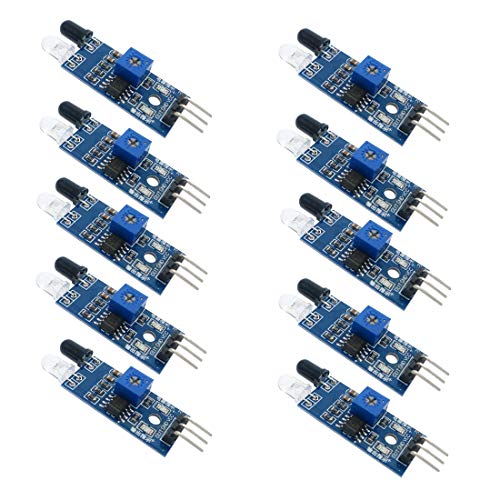
The HiLetgo 10pcs IR Infrared Obstacle Avoidance Sensor Module is an excellent choice for hobbyists and educators looking to enhance their Arduino projects. With an effective detection range of 2-30 cm and a detection angle of 35°, it’s perfect for obstacle avoidance and line tracking. You can easily adjust the detection distance using a potentiometer. The module operates on 3.3V-5V and connects directly to microcontrollers. While users appreciate its functionality, some report challenges with detecting dark objects and maintaining potentiometer settings. For short-range applications, it’s a reliable option to evaluate for your robotics endeavors.
Best For: hobbyists and educators looking to enhance their Arduino projects with obstacle avoidance and line tracking capabilities.
Pros:
- Easy installation with compatibility for various microcontrollers.
- Adjustable detection distance using an accessible potentiometer.
- Positive feedback on functionality and packaging, with all units tested working.
Cons:
- Limited detection range, especially with dark objects.
- Some users experienced difficulty maintaining potentiometer settings.
- A few units may be non-functional, with reports of 3 out of 10 not working.
Seco-Larm Enforcer Indoor/Outdoor Photoelectric Beam Sensor
Product not found or API error.
For those seeking a reliable security solution, the Seco-Larm E-931-S35RRQ Enforcer Indoor/Outdoor Photoelectric Beam Sensor stands out with its impressive 35-foot adjustable sensing range. This retro-reflective sensor uses an infrared LED to create an invisible beam, triggering alerts when interrupted. It’s weatherproof with an IP66 rating, making it perfect for any environment. Installation is easy, and it includes all necessary mounting hardware. Users appreciate its versatility for applications like driveway alarms and gate protection. With a response time of just 10ms and compatibility with various devices, it’s a solid choice for enhancing your security setup.
Best For: Those looking for a versatile and reliable security solution for indoor and outdoor applications, such as driveway alarms and gate protection.
Pros:
- Easy installation with all necessary mounting hardware included.
- Weatherproof with an IP66 rating, suitable for various environmental conditions.
- Compatible with multiple devices, enhancing security setup versatility.
Cons:
- Some users find reflector aiming challenging during installation.
- Recommendations for improvement include a built-in delay feature for relay outputs.
- A few users have noted the need for more secure mounting options for the sensor unit.
Gikfun Infrared Diode LED IR Emission and Receiver for Arduino (Pack of 10 Pairs)

Gikfun’s Infrared Diode LED IR Emission and Receiver pack is perfect for hobbyists and DIY enthusiasts looking to enhance their Arduino projects. This pack includes ten VS1838B infrared receivers and ten 5mm 940nm IR emission tube LED lamps, providing reliable components for various applications like remote controls and temperature measurement. With a built-in IC offering high resistance to interference, you can trust these diodes for consistent performance. Users appreciate their functionality with Arduino libraries, though they do need modulated IR light at 38 kHz for ideal use. Overall, this pack boasts a solid average rating of 4.5 stars from satisfied customers.
Best For: Hobbyists and DIY enthusiasts looking to enhance their Arduino projects with reliable infrared components.
Pros:
- High resistance to interference and environmental factors due to built-in dedicated IC.
- Compatible with Arduino libraries, making integration into projects straightforward.
- Long service life and reliability suitable for various applications, including remote controls and temperature measurement.
Cons:
- Requires modulated IR light at 38 kHz for optimal performance, limiting simple detection capabilities.
- Some users feel the pricing is slightly higher compared to wholesale rates.
- May not be ideal for users seeking a simple IR beam detection solution.
Frienda 20 Pieces IR Infrared Obstacle Avoidance Sensor Module

Ideal for hobbyists and educators, the Frienda 20 Pieces IR Infrared Obstacle Avoidance Sensor Module offers an excellent blend of affordability and functionality. Compatible with Arduino and Raspberry Pi, this 3-wire reflective sensor module lets you detect obstacles from 2-30 cm away, with an adjustable detection angle of 35 degrees. When an obstacle is detected, a green LED lights up, signaling action. While some users report shorter detection ranges, careful installation and alignment enhance performance. This module suits various applications, from robotics to DIY projects, making it a versatile addition to your electronic toolkit.
Best For: Hobbyists, educators, and DIY enthusiasts looking for an affordable and versatile obstacle detection solution.
Pros:
- Affordable price for a pack of 20 modules, making it budget-friendly for projects.
- Adjustable detection distance and angle, allowing customization for specific applications.
- Compatible with popular platforms like Arduino and Raspberry Pi, enhancing versatility.
Cons:
- Actual detection ranges reported by some users may be shorter than advertised.
- Requires careful alignment for optimal performance, which may be challenging for beginners.
- Mixed reviews on durability, with some units failing after limited use.
20pcs IR Infrared Obstacle Avoidance Sensor Modules for Arduino

The 20pcs IR Infrared Obstacle Avoidance Sensor Modules for Arduino stand out as a top choice for both hobbyists and professionals engaging in robotics projects. Operating on 3.3V-5V DC, these sensors offer a reliable detection range of 2-30cm, making them perfect for smart car robots and distance tracking applications. You’ll appreciate their seamless integration with Arduino, easy installation, and adjustable detection range provided by a stable LM393 comparator. With an impressive customer rating of 4.5 stars, these modules enable swift responses to surroundings, enhancing your project’s performance and ensuring effective obstacle detection and distance measurement.
Best For: Hobbyists and professionals looking for reliable obstacle detection and distance measurement in robotics projects.
Pros:
- Seamless integration with Arduino projects for enhanced functionality.
- Adjustable detection range with stable LM393 comparator for versatile applications.
- Easy installation with screw holes and 3-wire connectivity for user convenience.
Cons:
- Some users may misunderstand sensor outputs, as they provide state changes instead of analog values.
- Limited detection range of 2-30cm may not suit all advanced robotics needs.
- Potential for restocking fees if product condition is misrepresented upon return.
WWZMDiB Infrared Reflective Sensor Module for Arduino

For hobbyists and educators working on Arduino projects, the WWZMDiB Infrared Reflective Sensor Module stands out as a highly effective tool. This module, featuring three TCRT5000 sensors, excels in obstacle avoidance and line detection tasks. Operating on a DC voltage of 3.3-5V, it’s easy to integrate into your smart car robot designs. With a detection range of 1-25mm and adjustable sensitivity via a potentiometer, you can fine-tune its performance to suit various applications. Setup is straightforward, thanks to included jumper wires, making it a fantastic choice for anyone looking to enhance their Arduino projects efficiently.
Best For: Hobbyists and educators looking for an efficient and effective tool for Arduino projects involving obstacle avoidance and line detection.
Pros:
- Easy setup with included jumper wires allows for quick integration into projects.
- Adjustable sensitivity enables fine-tuning for various applications and environments.
- Versatile functionality supports multiple tasks such as line detection and obstacle avoidance.
Cons:
- Detection range is limited to 1-25mm, which may not suit all applications.
- The analog output (AO) is generally not connected, limiting its use for more advanced applications.
- Performance may vary based on surface color and reflectivity, requiring additional calibration in some cases.
Factors to Consider When Choosing Infrared Sensors
When you’re choosing infrared sensors, there are several key factors to keep in mind. You’ll want to evaluate the detection range, power supply needs, and how easy they are to mount and install. Don’t forget to check their sensitivity and compatibility with your microcontrollers to guarantee the best fit for your project.
Detection Range Considerations
Choosing the right infrared sensor involves careful consideration of its detection range, as various factors can impact performance. Typically, these sensors have a detection range of 2 to 30 cm, which varies based on the sensor type and the surface reflectivity of the detected obstacles. You can adjust the detection range using a potentiometer, allowing you to calibrate sensitivity for your specific needs. Environmental factors, such as lighting and the color or texture of obstacles, also play a significant role—shiny surfaces usually yield better results. Additionally, the detection angle is about 35 degrees, impacting the area for obstacle detection. Be mindful that performance may decline in bright sunlight or against dark surfaces, especially for outdoor applications.
Power Supply Requirements
While selecting an infrared sensor, understanding power supply requirements is vital to confirm peak performance. Most infrared sensors operate within a voltage range of 3.3V to 5V DC, making compatibility with microcontroller systems significant. You’ll want to verify the power supply remains stable, as fluctuations can negatively impact the sensor’s reliability in detecting obstacles or lines. Additionally, some sensors offer adjustable sensitivity through potentiometers, letting you fine-tune detection distances for your specific application. Keep in mind that higher power demands might limit the portability of battery-operated projects, so consider your power source options carefully. Ultimately, the choice of power supply can affect both the detection range and accuracy, especially on different surface types that reflect infrared signals.
Mounting and Installation Ease
Mounting and installation ease is essential for successfully integrating infrared sensors into your projects. When choosing a sensor, look for mounting holes or brackets that guarantee secure installation and proper alignment. Keep in mind that the sensor’s size and weight can influence your mounting options; lighter sensors fit well in tight spaces. Detailed installation instructions or diagrams can make the setup process smoother, especially if you’re not highly technical. Also, verify that the sensor’s dimensions match your intended installation area, as larger models may need specific configurations. Finally, verify the power and signal connections are straightforward; models with clearly labeled connections and adequate wire lengths will save you time and reduce complexity during installation.
Sensitivity and Adjustability
When selecting infrared sensors, sensitivity and adjustability play vital roles in ensuring effective performance across various applications. The type of surface the sensor detects greatly influences sensitivity; shiny surfaces typically yield better results due to their higher reflectivity. Many sensors come with an adjustable potentiometer, allowing you to modify the detection distance easily. Turning it clockwise usually increases the range, while counterclockwise decreases it. Most infrared sensors have an effective detection range of 2-30 cm, but remember, actual performance can vary based on environmental conditions and surface characteristics. Sensitivity adjustments are especially important for applications involving various surface types since black or dark surfaces can markedly reduce detection range, impacting overall effectiveness in your projects.
Compatibility With Microcontrollers
To guarantee seamless integration of infrared sensors with microcontrollers, it’s essential to take into account several compatibility factors. First, verify the sensor operates within a voltage range compatible with your microcontroller, typically between 3.3V to 5V for Arduino-compatible modules. Next, check the output type; some sensors provide analog signals while others offer digital outputs, so make certain they match your microcontroller’s input capabilities. Don’t forget to verify the pin configuration (VCC, GND, OUT) for proper connections. Additionally, consider the sensor’s detection distance and angle specifications, as these can impact performance in your application. Finally, look for sensors with adjustable settings like potentiometers to fine-tune their performance for your specific microcontroller projects.
Environmental Resistance Features
Choosing the right infrared sensor involves more than just technical specifications; you also need to take into account its environmental resistance features. Look for weatherproof ratings like IP66, ensuring the sensor can handle dust and water exposure for outdoor use. Operating temperature ranges matter too; a sensor should function reliably within limits, such as -4°F to 131°F, to adapt to various climates. Consider the materials and design, as some sensors resist oxidation and corrosion, prolonging lifespan in harsh conditions. Additionally, built-in interference resistance can enhance performance in environments with fluctuating ambient light. Finally, pay attention to installation factors like mounting options and alignment flexibility to guarantee top performance in diverse settings.
Application Suitability and Use Cases
While evaluating infrared sensors, it’s essential to assess their suitability for specific applications and use cases. In robotics, for instance, these sensors excel in obstacle avoidance and line tracking, with detection ranges typically between 2-30 cm. You’ll appreciate models that offer adjustable detection distances, allowing you to fine-tune sensitivity for different environments. Compatibility with microcontrollers like Arduino enhances their versatility, making them perfect for DIY projects. Keep in mind that the effectiveness of these sensors often hinges on the target surface’s color and texture; reflective surfaces yield better results. Additionally, infrared sensors are significant in assembly line counting and monitoring systems, where accurate object detection is crucial for operational efficiency and productivity.


