

If you’re involved in technology projects like automation, robotics, or drones, having reliable electronic speed controllers (ESCs) is crucial for optimal performance.
Consider options such as the 40A Brushless ESC for drones, the Cdmall AC Motor Controller, or the Newzoll High-Power DC Controller, which accommodate various voltage ranges.
When selecting an ESC, prioritize safety features, user-friendly interfaces, and efficient firmware.
Each controller offers distinct advantages, so you’ll want to identify the best fit for your specific projects as you dive deeper into the world of technology.
40A Brushless ESC Speed Controller for RC Drones

When exploring the fascinating realm of technology, particularly in automation and robotics, the 40A Brushless ESC from Nuofany emerges as an exceptional choice for enthusiasts seeking reliability and performance in their RC drones. This speed controller delivers continuous currents of 40A and can handle short bursts up to 55A, ensuring smooth flight dynamics. Its compatibility with 2-4 lithium batteries offers versatile power options for various setups. The ESC is equipped with essential safety features, such as low pressure cut-off and overheat protection, to keep your system secure. Additionally, the XT60 connector guarantees a reliable connection. Whether you’re working with 2-pole or 12-pole motors, this ESC seamlessly adapts, enhancing your overall flying experience.
Best For: Tech enthusiasts and hobbyists seeking a dependable and efficient speed controller for their RC drones and multi-axis aircraft.
Pros:
- High Output Capacity: Supports continuous current of 40A and short bursts up to 55A, optimizing performance for demanding applications.
- Comprehensive Safety Features: Includes low pressure cut-off, overheat protection, and throttle signal loss protection for enhanced safety.
- Versatile Compatibility: Compatible with various brushless motors and 2-4 lithium batteries, allowing for flexible configurations.
Cons:
- Limited to Lithium Batteries: Compatibility is restricted to lithium battery types, which may not suit all users.
- No Built-in Battery Protection: Requires external battery management systems to ensure safety during operation.
- Potential Overkill for Smaller Drones: Might offer more power than necessary for smaller or less demanding RC setups, making it less efficient in those cases.
Cdmall AC Motor Speed Controller (120V, 15A)
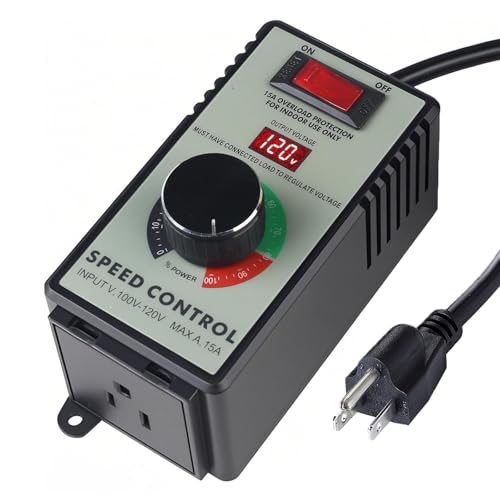
The Cdmall AC Motor Speed Controller is an ideal solution for enthusiasts in the fields of automation and robotics who require precise control over their brushed AC motors. This multifunctional controller is compatible with a wide range of devices, from fans to grinders, making it a valuable addition to any tech toolkit. You’ll appreciate its real-time voltage display for exact adjustments, along with the stepless speed control that allows for fine-tuning performance to meet specific project needs. Built with overload protection and a durable design, this controller is engineered for longevity. However, it’s important to note that it’s not compatible with brushless motors or appliances featuring electronic circuit boards. Elevate your technological projects with this dependable speed controller!
Best For: Hobbyists, DIY enthusiasts, and tech professionals looking for precise control over brushed AC motors across various applications in automation and robotics.
Pros:
- Real-time voltage display for accurate adjustments during operation.
- Stepless variable speed control enables fine-tuning of motor speed, light brightness, or heater temperature.
- Overload protection with a built-in circuit breaker ensures safety and simplifies resets.
Cons:
- Not compatible with brushless motors or appliances with electronic circuit boards.
- Recommended working current is limited to 10A for extended use, which may restrict certain applications.
- Portable hook design may not be suitable for all mounting situations.
Gugxiom 4000W 100-120V AC Motor Speed Controller Angle Grinder
Product not found or API error.
For technology enthusiasts exploring automation, robotics, and AI advancements, the Gugxiom 4000W AC Motor Speed Controller is a standout choice. Its compatibility with over 30 types of equipment makes it an essential tool for various tech projects. Whether you’re working on fans, power tools, or tungsten lamps, this controller efficiently manages resistive, inductive, and capacitive loads. Constructed from robust ABS material, it offers high temperature resistance, complemented by built-in 15A overload protection to safeguard your equipment. You’ll also appreciate the clear LED display and high-precision potentiometer knob, which facilitate smooth adjustments. Simply set the knob to ‘0’ before plugging into a 110V-120V socket, and you’re all set to enhance your project experience.
Best For: Tech enthusiasts, hobbyists, and DIYers looking for a versatile speed controller for a variety of devices.
Pros:
- Versatile Compatibility: Supports over 30 equipment types, perfect for a range of tech applications.
- Safety Features: Built-in 15A overload protection shields against voltage spikes.
- User-Friendly Interface: LED display and high-precision knob enable effortless adjustments and monitoring.
Cons:
- Limited Power Thresholds: May not support devices exceeding specified wattage limits (2000W/500W/300W).
- Learning Curve: Initial setup requires careful attention to ensure correct voltage settings.
- Potential Heat Issues: Extended high-load use could lead to overheating, despite flame-retardant materials.
Newzoll High-Power 40A DC Motor Speed Controller, 12V 24V 36V 48V

Looking for a reliable speed controller for your high-power DC motor projects? The Newzoll High-Power 40A DC Motor Speed Controller is an excellent choice for enthusiasts in automation and robotics. With an operating voltage range of 10V to 50V, it efficiently supports systems at 12V, 24V, 36V, and 48V. Its continuous current capacity of 40A and maximum current of 60A ensure robust performance for various applications. You’ll appreciate the built-in 2 x 80A high current relay, allowing for seamless forward and reverse speed control. Compact at 100 mm x 76 mm x 28 mm, it fits well in diverse projects, making it a must-have for hobbyists and engineers alike.
Best For: Automation enthusiasts and engineers seeking a high-power DC motor speed controller for versatile applications.
Pros:
- High continuous current capacity of 40A, delivering robust performance in demanding scenarios.
- Versatile operating voltage range (10V to 50V) compatible with 12V, 24V, 36V, and 48V systems.
- Built-in relay mechanism for both forward and reverse speed control, enhancing usability in various technology projects.
Cons:
- Size may be a constraint for compact applications, measuring 100 mm x 76 mm x 28 mm.
- Maximum current of 60A might be insufficient for some very high-power setups.
- Limited detailed technical support may be a concern for novice users unfamiliar with DC motor controllers.
BOJACK Low Voltage DC Motor Speed Controller (Pack of 2)

If you’re exploring low voltage DC motor projects within the realms of automation and robotics, the BOJACK Low Voltage DC Motor Speed Controller is an excellent choice. This convenient pack of two controllers operates within a voltage range of 2.2V to 15V, providing adjustable output from 1.8V to 15V. With a maximum output power of 30W and a continuous output current of 2A, it’s ideal for a variety of tech-driven home improvement applications. The built-in self-recovery fuse enhances safety by disconnecting during excessive current and automatically reconnecting once cooled. You’ll appreciate the flexibility of the adjustable duty cycle, allowing for effortless performance fine-tuning.
Best For: Hobbyists and DIY enthusiasts in automation and robotics looking for a dependable low voltage DC motor speed controller for innovative projects.
Pros:
- Adjustable Duty Cycle: Provides 0%-100% duty cycle for precise speed control, essential for automation tasks.
- Self-Recovery Fuse: Increases safety by automatically disconnecting during overloads and reconnecting after cooling.
- Versatile Voltage Range: Operates efficiently within a voltage range of 2.2V to 15V, suitable for various applications.
Cons:
- Limited Maximum Current: The maximum continuous output current of 2A may not meet the demands of high-performance applications.
- Output Power Restriction: Maximum output power of 30W may limit usage in larger or more complex projects.
- Basic Design: Lacks advanced features found in higher-end motor controllers, which may be necessary for specialized applications.
Electronic Speed Controller Firmware and Configuration Guide
Product not found or API error.
Electronic Speed Controllers (ESCs) play a crucial role for hobbyists seeking precise control in drones and RC vehicles, as well as in various automation and robotics applications. To maximize the performance of your ESC, it’s essential to focus on firmware and configuration. Properly adjusting parameters like throttle range and timing can significantly enhance efficiency and responsiveness. Don’t underestimate the importance of signal protocols such as PWM and OneShot; they can greatly impact system responsiveness. Furthermore, adopting noise filtering techniques—both hardware and software—can substantially improve stability.
Explore advanced firmware features, including telemetry, for valuable insights into performance metrics. Regular firmware updates and community contributions are vital for optimizing your ESC’s capabilities, ensuring you remain at the cutting edge of technology. Enjoy the journey!
Best For: Hobbyists and enthusiasts in drones, RC vehicles, automation, and robotics seeking precise control and optimization.
Pros:
- Enhanced Performance: Proper configuration boosts efficiency and responsiveness significantly.
- Advanced Features: Access to telemetry and adaptive control offers deeper insights into system performance.
- Community Support: Regular firmware updates and user contributions enhance capabilities.
Cons:
- Complex Setup: Initial configuration can be daunting for newcomers.
- Signal Sensitivity: Performance may be influenced by signal quality and interference.
- Cost of Upgrades: Accessing advanced firmware features might necessitate additional hardware investments.
DC Motor Speed Controller for 12V/24V Systems
Product not found or API error.
The GERUSEA DC Motor Speed Controller is an excellent choice for hobbyists and tech enthusiasts looking for reliable speed adjustments in 12V or 24V systems. With an overload current of 10A, it efficiently supports up to 120W at 12V and 240W at 24V, making it adaptable for a wide range of applications, from automation projects to robotics. You’ll appreciate the user-friendly speed adjustment and straightforward wiring, which comes with clear instructions for connecting the red, blue, and black wires. The upgraded design features a heat sink for enhanced heat dissipation, ensuring durable performance even during extended use. Whether you’re fine-tuning fan speeds or managing motor performance, this controller delivers efficiency and effectiveness.
Best For: Hobbyists, DIY enthusiasts, and tech innovators seeking a dependable solution for controlling the speed of 12V or 24V DC motors in various projects.
Pros:
- Simple installation with clear wiring instructions, making it accessible for all skill levels.
- Enhanced design includes a heat sink for better heat management, promoting longevity.
- Versatile usage, suitable for applications ranging from fan speed control to advanced robotics.
Cons:
- Limited to a maximum overload current of 10A, which may not be adequate for some high-demand applications.
- Basic wiring knowledge is required for proper installation and setup.
- Compatibility may vary with different types of DC motors, depending on specific project requirements.
Factors to Consider When Choosing Electronic Speed Controllers
When selecting electronic speed controllers, especially in the realms of automation, robotics, and AI advancements, it’s crucial to consider several key factors. Ensure compatibility with your motor to maintain optimal performance. Choose the appropriate current rating based on your application requirements, and verify the voltage range to match your system specifications. Additionally, prioritize safety features, as they are vital for protecting your equipment and ensuring reliable operation in various technological environments.
Factors to Consider When Choosing Electronic Speed Controllers
Choosing the right electronic speed controller (ESC) is crucial for optimizing your technology projects, especially in areas like automation and robotics. Several factors can significantly influence performance. First, assess the current rating; ensure the ESC can handle both continuous and peak currents of your motor. Next, verify voltage compatibility to prevent any damage—using an ESC rated for the wrong voltage can compromise both the controller and motor. Determine if the ESC is compatible with your motor type, whether brushed or brushless, as these are not interchangeable. Look for essential protection features such as overheat and low voltage cut-off to enhance safety. Lastly, consider adjustability and calibration options, which allow you to fine-tune performance based on your motor’s characteristics, ensuring optimal results for your projects in AI and robotics.
Motor Compatibility Requirements
Understanding motor compatibility is essential for optimizing your electronic speed controller (ESC) within various technological applications, such as automation and robotics. First, ensure your ESC is compatible with the motor type; some ESCs are designed specifically for brushed motors, while others are tailored for brushless motors commonly used in advanced robotics and AI systems. Next, verify the voltage requirements for both the ESC and the motor—mismatched voltages can lead to inefficiencies or potential damage, especially in automated systems where reliability is crucial.
Additionally, consider the continuous and peak current ratings of the ESC to ensure it can meet your motor’s demands without overheating, which is vital for maintaining performance in high-stakes environments like robotics. RPM compatibility is another important factor; certain ESCs are configured for specific setups, affecting their maximum speed and efficiency. Finally, look into the timing adjustment features, as proper timing settings are critical for achieving peak performance, especially when integrating different brushless motors in sophisticated AI applications.
Current Rating Selection
Selecting the Right Current Rating for Your ESC
Choosing the appropriate current rating for your electronic speed controller (ESC) is crucial for achieving optimal performance and durability in various technological applications, such as automation and robotics. Your ESC’s current rating should meet or exceed the continuous current requirements of your motor to prevent overheating and potential damage.
For optimal safety, aim for an ESC with a current rating that is at least 20-30% higher than your motor’s maximum continuous current draw. It’s important to note that short-time current ratings indicate the maximum current an ESC can briefly handle; ensure this is adequate for your motor’s peak demands.
If you’re integrating multiple motors, consider their combined current requirements and opt for ESCs equipped with built-in safety features, like overload protection, to enhance reliability in your systems. This approach not only safeguards your components but also supports the advancements in AI and robotics by ensuring consistent operation under various conditions.
Voltage Range Specification
Voltage Range Specification for ESCs in Technology Applications
When evaluating electronic speed controllers (ESCs) within various technology domains, including automation and robotics, assessing the voltage range specification is essential. This factor directly influences compatibility with your motor and overall system performance. ESCs typically have a defined operating voltage range—such as 10V to 50V for DC applications—which must align with your power source for optimal efficiency.
Operating an ESC outside its specified voltage range can lead to damage or even failure of the unit. Additionally, exceeding the maximum voltage may trigger built-in protective features or cause irreversible harm. It’s also vital to consider the continuous and peak current ratings alongside the voltage range to ensure that the ESC can manage the load effectively without overheating. This meticulous selection process will enhance both safety and reliability in your tech projects, whether in robotics or AI advancements.
Safety Features Importance
Safety features in electronic speed controllers (ESCs) are essential across various technological applications, including automation, robotics, and AI advancements. These features protect both your equipment and projects from potential failures. For instance, overload protection is crucial, as it cuts power when the current exceeds safe limits, preventing damage to your system. Low pressure cut-off features are equally important; they ensure your battery doesn’t drain excessively, avoiding permanent harm to your devices. Overheat protection helps maintain safe operating temperatures, significantly reducing fire hazards and the risk of component failures. Moreover, throttle signal loss protection enhances safety by preventing accidental motor operation if the controller signal is lost. Many ESCs also feature a self-recovery fuse, which automatically disconnects during excessive current situations and restores functionality once the issue is resolved, minimizing maintenance needs and ensuring your projects run smoothly.
Control Method Options
Understanding the various control method options for electronic speed controllers (ESCs) is essential for achieving optimal performance in technology projects, particularly in automation and robotics. ESCs commonly utilize Pulse Width Modulation (PWM) to adjust motor power by varying voltage pulse widths, allowing for precise speed control. Advanced ESCs may support protocols like OneShot and Multishot, which enhance responsiveness and reduce latency compared to traditional PWM, making them particularly useful in high-performance robotic applications. The control method you select can significantly impact motor efficiency, resulting in smoother acceleration and deceleration. Additionally, many ESCs provide configuration options, such as timing adjustments tailored for specific motor types, which can be crucial in robotics and automation systems. Proper calibration of the control method is vital, as it influences throttle range and braking behavior, ensuring your technology performs at its best.
Size and Weight Considerations
Size and Weight Considerations for Electronic Speed Controllers (ESC)
When selecting the right size and weight for your electronic speed controller (ESC), it’s crucial, especially in applications involving automation and robotics where space can be limited. ESCs come in various dimensions; for high-power systems, sizes like 100mm x 76mm x 28mm are common. Weight is another critical factor, particularly for drones and robotic systems, where lightweight models can weigh as little as 50 grams, while more robust options may exceed 200 grams.
Larger ESCs typically handle heat more efficiently due to their increased surface area, which can be advantageous in high-performance applications. When choosing an ESC, consider how its size will influence your layout and mounting options in your technology project. A compact ESC can simplify installation, but it may come with trade-offs regarding cooling efficiency and power handling capabilities. Finding the right balance is essential to optimize performance in your automation or robotics designs.
User Interface Design
When selecting an electronic speed controller (ESC), the user interface plays a crucial role in enhancing your overall experience and control in various tech applications, including automation and robotics. A clear LED display for real-time voltage and speed monitoring significantly improves interaction, allowing you to keep track of performance seamlessly. Opt for user-friendly knobs or potentiometers that facilitate stepless adjustments, enabling precise control of motor speed, which is essential in AI-driven systems. An intuitive layout of controls and indicators reduces the learning curve, making it accessible for both beginners and seasoned users. Incorporating tactile feedback in buttons and knobs enhances your adjustments during operation, ensuring a more engaging experience. Additionally, visual indicators like warning lights or alarms for overload protection help you quickly identify issues, ensuring safe operation and peace of mind as you explore the latest advancements in technology.


