

When choosing the best DC-DC converters for your projects in 2025, consider options like the Pro Chaser Voltage Reducer for RVs, the versatile 12V 20A Step Down Converter, and the adjustable 5 Pack LM2596 Buck Converters. You might also look at the compact 20A 240W Voltage Converter and the waterproof LM2596 Voltage Regulator. Don’t overlook the PlusRoc USB Type-C Adapter and the powerful Cllena Boost Converter. Keep reading for more insights and details on each model.
Pro Chaser DC-DC Voltage Reducer for Golf Carts and RVs

If you’re looking to power accessories in your golf cart or RV, the Pro Chaser DC-DC Voltage Reducer is an excellent choice. This compact converter efficiently converts 36V to 48V down to a reliable 12V output, delivering up to 10A of current. Weighing just 4.8 ounces, its aluminum shell guarantees durability and water resistance. Installation is a breeze with clearly marked wires, making it user-friendly. Most customers rave about its performance for powering lights and radios. However, keep an eye on potential overheating issues. Overall, it’s a top contender for anyone needing trustworthy power on the go.
Best For: Golf cart and RV owners looking to efficiently power 12V accessories from a 36V to 48V battery system.
Pros:
- Efficient Power Conversion: Converts high voltage (36V to 48V) to a stable 12V output, ideal for various accessories.
- User-Friendly Installation: Clearly marked wiring and compact design make installation straightforward for most users.
- Durable and Water-Resistant: Constructed with an aluminum shell, ensuring longevity and reliability in various conditions.
Cons:
- Overheating Issues: Some users have reported overheating, which may require monitoring during operation.
- Potential Defects: A few customers experienced unit failures due to defects, affecting overall reliability.
- Modification for Fitment: Some users had to modify their golf carts for proper installation, which may not be ideal for everyone.
12V 20A Step Down Converter, DC Voltage Reducer for Vehicles

The 12V 20A Step Down Converter is an ideal solution for vehicle enthusiasts who need a reliable way to power 12V devices directly from higher voltage sources. With an input voltage range of 17V-55V and a fixed output of 12V, you can easily run devices like LED lights and monitoring systems. Its aluminum case guarantees durability, while built-in protections guard against short circuits and over-voltage. With a remarkable efficiency of up to 96%, this converter supports applications in various vehicles, from trucks to golf carts. At just 8.5 ounces, it’s a lightweight yet powerful addition to your setup.
Best For: Vehicle enthusiasts looking to power 12V devices from higher voltage sources efficiently and reliably.
Pros:
- High Efficiency: Conversion efficiency of up to 96% minimizes energy loss.
- Durable Construction: Aluminum case with silicone sealing ensures longevity and protects against environmental factors.
- Built-In Protection: Features short-circuit, over-current, over-voltage, and overload protection for safe operation.
Cons:
- Fixed Output Voltage: Limited to a fixed output of 12V, which may not suit all applications.
- Weight: At 8.5 ounces, it may be considered heavier compared to some lightweight alternatives.
- Best Sellers Rank: Lower visibility in the market with a rank of #52,884 in Tools & Home Improvement.
5 Pack LM2596 DC to DC Buck Converter Power Supply Step Down Module

For hobbyists and DIY enthusiasts looking to power various devices, the 5 Pack LM2596 DC to DC Buck Converter is an excellent choice. With an input voltage range of 3V to 40V and adjustable output from 1.5V to 35V, it suits many applications. Each module can deliver up to 3A, making it ideal for projects like powering Raspberry Pi or reducing voltage for sensors. The blue potentiometer simplifies voltage adjustments, though you might need several turns for noticeable changes. Just remember, at lower voltages, efficiency can drop below 75%, so consider your heat management needs.
Best For: Hobbyists and DIY enthusiasts seeking a versatile power supply solution for various electronic projects.
Pros:
- Versatile Input and Output: Supports a wide input voltage range (3V to 40V) and adjustable output (1.5V to 35V), making it suitable for diverse applications.
- High Current Capability: Each module can deliver up to 3A, allowing it to power demanding devices like Raspberry Pi and fans.
- User-Friendly Adjustment: Features a blue potentiometer for easy voltage adjustments, facilitating customization for different project needs.
Cons:
- Efficiency Issues: At lower output voltages, efficiency can drop below 75%, potentially leading to overheating without proper heat management.
- Adjustment Difficulty: Users may find it challenging to adjust the output voltage, requiring multiple turns of the adjustment screw to see changes.
- No Display for Verification: Lacks a built-in display for voltage readings, necessitating the use of a multimeter for accurate verification.
20A 240W DC to 12V Voltage Converter

Engineered for both reliability and high efficiency, the 240W DC to 12V Voltage Converter is an ideal choice for those seeking to power demanding applications like golf carts and off-grid setups. With an input voltage range of 18V to 60V and an impressive efficiency of over 95%, it guarantees constant performance. Weighing just 248 grams, its compact design fits easily into tight spaces. The smart chip offers multiple protections against issues like over-current and short-circuits, while the IP68 rating assures waterproof security. Customer feedback highlights its reliability, especially in challenging environments. Plus, you get a one-year warranty for peace of mind.
Best For: Those looking to efficiently power golf carts, campers, and off-grid setups with a reliable and waterproof voltage converter.
Pros:
- High efficiency of over 95% ensures optimal performance.
- IP68 waterproof rating provides excellent protection in challenging environments.
- Smart chip technology includes multiple protection features for safe operation.
Cons:
- Some users reported initial wiring issues that needed correction.
- Limited to a specific output voltage of 12V, which may not suit all applications.
- May require additional installation expertise for optimal use in complex setups.
LM2596 DC-DC Buck Converter Voltage Regulator (Pack of 2)

With its adjustable output voltage range from 1.25 to 37V, the LM2596 DC-DC Buck Converter Voltage Regulator (Pack of 2) is an ideal choice for hobbyists and DIY enthusiasts. You’ll appreciate its input voltage of DC 4.0-40V and a peak current of 3A, making it versatile for various projects. The built-in voltmeter lets you monitor voltage in real-time, while the self-calibration feature eliminates soldering hassles. Just remember, you need a load for voltage adjustment. Although some users find initial adjustments tricky, it maintains steady voltage under varying conditions. Overall, it’s a reliable tool for your power supply needs.
Best For: Hobbyists and DIY enthusiasts looking for a versatile and adjustable power supply solution for their projects.
Pros:
- Built-in voltmeter allows for real-time voltage monitoring, making adjustments easier.
- Self-calibration feature eliminates the need for soldering, enhancing convenience.
- Steady output voltage is maintained even under varying input and load conditions.
Cons:
- Output voltage cannot be adjusted without a load, making initial setup challenging.
- Some users report difficulty in making accurate voltage adjustments at first.
- Potential for heat generation during significant voltage adjustments may be a concern.
PlusRoc Waterproof DC-DC Step Down Converter Power Adapter (USB Type-C)

The PlusRoc Waterproof DC-DC Step Down Converter Power Adapter is an excellent choice for hobbyists and professionals who need a reliable and efficient power solution for their devices. This converter accepts an input voltage of DC 8-32V, ideally at 12V or 24V, and outputs a steady 5V at 3A with up to 96% efficiency. It’s perfect for powering Raspberry Pi 4, dash cams, and more. With its compact design and easy installation via screw brackets, you’ll appreciate its versatility for projects, from solar-powered devices to clean vehicle installations. Plus, the built-in protection features guarantee your devices stay safe.
Best For: Hobbyists and professionals looking for a reliable and efficient power solution for devices that require 5V at 3A.
Pros:
- Up to 96% efficiency ensures minimal energy loss during operation.
- Compact design with screw brackets allows for easy installation in various setups.
- Built-in protection features safeguard against overload, over-current, overheat, and low voltage.
Cons:
- Limited to a maximum output of 3A, which may not be sufficient for higher-demand devices.
- Requires a compatible input voltage (DC 8-32V) which may not be available in all setups.
- Waterproof design may not be necessary for all users, potentially adding to the cost.
Cllena DC/DC 12V to 24V Boost Converter 25A 600W
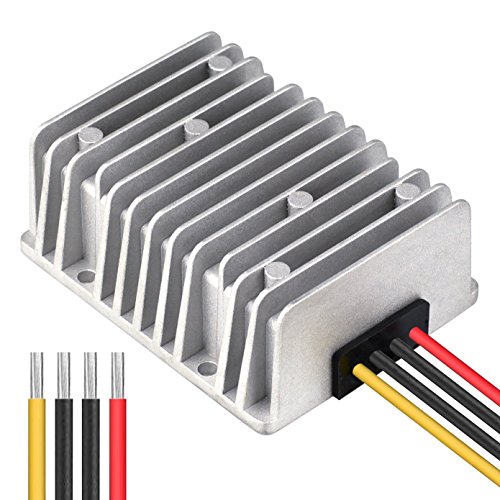
For those seeking reliable power solutions in demanding environments, the Cllena DC/DC 12V to 24V Boost Converter stands out with its impressive 600W output capability. With an input voltage range of DC 10V-16V, it delivers a steady 24V at 25A, making it perfect for various applications like trucks and car audio systems. Its high conversion efficiency of up to 95% guarantees minimal energy loss. Built with a durable aluminum shell, it’s waterproof and dust-proof, making it ideal for tough conditions. Plus, safety features like over-current and short-circuit protection give you peace of mind while using it.
Best For: Individuals and businesses needing a robust and efficient power solution for demanding applications such as trucks, car audio systems, and other electronic devices.
Pros:
- High conversion efficiency of up to 95%, ensuring minimal energy loss.
- Durable aluminum shell with waterproof and dust-proof features for enhanced longevity.
- Comprehensive safety protections including over-load, over-current, and short-circuit safeguards.
Cons:
- Non-adjustable output voltage may not suit all specific voltage requirements.
- Maximum output current of 25A may limit use for higher power applications.
- Requires heat management if operating temperatures exceed 40℃ to prevent damage.
Factors to Consider When Choosing Dc Dc Converters
When you’re choosing a DC-DC converter, you need to contemplate several key factors. Input voltage range, output voltage stability, and current rating capacity all play an essential role in ensuring your project runs smoothly. Don’t forget to check efficiency and loss, as well as any protection features included, to safeguard your setup.
Input Voltage Range
Choosing the right input voltage range for your DC-DC converter is essential for ensuring compatibility with your power sources. Many converters are designed to work within specific ranges, like 36V to 48V or 17V to 55V. Make sure your input voltage exceeds the output by at least 1.5V to maintain efficiency and stability. Operating outside this range can lead to inefficiency, instability, or even damage to the converter. Additionally, some converters are tailored for particular applications, such as automotive or renewable energy systems, which dictate their input requirements. Understanding the input voltage range helps you select a converter capable of handling transient voltages, ensuring reliable performance in various conditions. Always verify these specifications before making a choice.
Output Voltage Stability
Once you’ve established the right input voltage range, the next critical aspect to contemplate is output voltage stability. This stability is essential for ensuring your connected devices receive a consistent voltage level, promoting reliable operation and longevity. A stable output minimizes fluctuations that could cause your electronic components to malfunction or overheat. High-quality DC-DC converters often utilize advanced technologies like synchronous rectification and intelligent chips to maintain voltage levels. Additionally, converters with efficiency ratings above 90% tend to offer better stability, as they reduce energy loss and heat generation. Don’t forget to evaluate load conditions, too, since some converters might experience voltage drops or spikes under varying loads, which can impact overall performance.
Current Rating Capacity
Understanding the current rating capacity of a DC-DC converter is essential, as it determines how much electrical current the device can safely supply to your load. The current capacity, typically measured in amps (A), should match or exceed the requirements of your connected devices to avoid overheating and damage. For example, a converter rated at 10A can support devices drawing up to 10A but isn’t suitable for those needing more. Don’t forget to take into account transient currents; some devices may require higher currents during startup or peak operation, so choose a converter with a higher capacity if necessary. Finally, keep in mind that lower efficiency can generate extra heat, reducing the effective current capacity for continuous operation.
Efficiency and Loss
When evaluating DC-DC converters, efficiency plays an essential role in your project’s success. Look for models with high efficiency ratings, ideally around 96%, to minimize energy loss during voltage conversion. Pay attention to the output voltage ripple; lower ripple often means better performance and less wasted energy. Consider converters that utilize synchronous rectification technology, as this greatly reduces power loss compared to traditional methods. Be cautious with low output voltages, as efficiency can drop below 75%, leading to overheating and performance issues. Finally, remember that excessive heat generation can affect the longevity and reliability of your converters, so guarantee effective heat dissipation measures are in place to maintain ideal operation.
Protection Features Included
Choosing a DC-DC converter with the right protection features can greatly enhance the reliability and safety of your project. Look for over-current protection to prevent excessive current flow that could damage your device or other components. Over-voltage protection is also important; it safeguards against voltage spikes, ensuring stable operation. Short-circuit protection is essential too, as it automatically shuts down the converter during a short circuit, reducing fire risks or equipment failure. Additionally, thermal protection can help by shutting down the device if it overheats, protecting both the converter and connected devices. Finally, built-in overload protection prevents damage by either reducing output or shutting off when load demands exceed the converter’s capacity. These features are crucial for safe and efficient operation.
Size and Weight
While you might focus on the technical specifications of a DC-DC converter, its size and weight are just as essential in determining its suitability for your project. The dimensions can vary considerably, with compact options like 2.9 x 2.9 x 1.22 inches to larger models at 5.6 x 2.1 x 1.5 inches. If you’re working in tight spaces, choosing a smaller, lighter model around 4.8 ounces is ideal for portable devices or vehicles. Remember, weight also impacts ease of installation and portability. Additionally, larger converters often offer better heat dissipation, which can be crucial for performance. So, consider how size and weight will affect your installation and the overall balance of your system before making a choice.


