

If you’re a technician, you know reliable cable testers are essential for diagnosing network issues. Top picks for 2025 include the TREND Networks VDV II Plus for versatile testing, Elite Core OSP CT-04C for durability, and Klein Tools Cable Tester Kit for in-depth fault detection. The Mackie Cable Tester offers quick checks, while the MFL. 15-Plug provides multi-cable capability. For added features, check out the Klein Tools VDV526-200 and the multifunction RJ45. Stick around to explore more options and insights!
TREND Networks VDV II Plus Cable Verifier (R158008)

If you’re a professional installer looking for a versatile tool that simplifies cable testing, the TREND Networks VDV II Plus Cable Verifier (R158008) is an excellent choice. This cloud-connected device tests copper cables for voice, data, and video, streamlining your installations. With integrated RJ-11, RJ-45, and coax F-Type connectors, you won’t need separate testers. The larger display and hub blink function enhance usability, while Bluetooth capabilities let you save reports effortlessly. Users appreciate its efficiency in identifying cable faults, though some find the app and manual challenging. Overall, it’s a solid investment for effective troubleshooting and testing.
Best For: Professional installers looking for a versatile and efficient tool for cable testing in voice, data, and video applications.
Pros:
- Integrated connectors for testing voice, data, and video cables eliminate the need for multiple devices.
- Bluetooth functionality allows for easy saving and sharing of professional PDF reports via the TREND AnyWARE Cloud App.
- Advanced troubleshooting capabilities help identify cable faults and measure cable lengths effectively.
Cons:
- Some users report challenges with the app and manual, indicating a steep learning curve for new users.
- Mixed reviews on value for money, with some feeling the device lacks advanced features compared to competitors.
- Reports of missing documentation and complicated manuals can cause confusion during initial setup.
Elite Core OSP CT-04C Cable Tester, Speaker

The Elite Core OSP CT-04C Cable Tester is an essential tool for audio professionals who need to guarantee their gear operates flawlessly. This versatile tester checks various cable types, including XLR, TRS, and MIDI. Simply plug each end into the designated connectors, turn the knob, and watch the LEDs confirm continuity and connection status. With heavy-duty metal construction and a 9-way switch for selecting connections, it’s built to last. Weighing just 1.84 pounds, it’s portable enough for any gig. Users rave about its reliability and ease of use, making it a must-have for anyone in the audio industry.
Best For: Audio professionals and musicians who require a reliable and versatile tool to test various cable types.
Pros:
- Easy to use: Simple plug-and-play operation with LED indicators for quick status checks.
- Durable design: Heavy-duty metal construction ensures longevity and reliability on the road.
- Versatile compatibility: Tests a wide range of cable types, making it suitable for various audio applications.
Cons:
- No manual included: Users have suggested a need for a manual or chart to help interpret LED light sequences.
- Battery not included: Requires a standard 9V battery, which is not provided with the tester.
- Limited shipping dimensions: Slightly larger dimensions may make it less portable in some cases compared to other testers.
Klein Tools Cable Tester Kit with Scout Pro 3
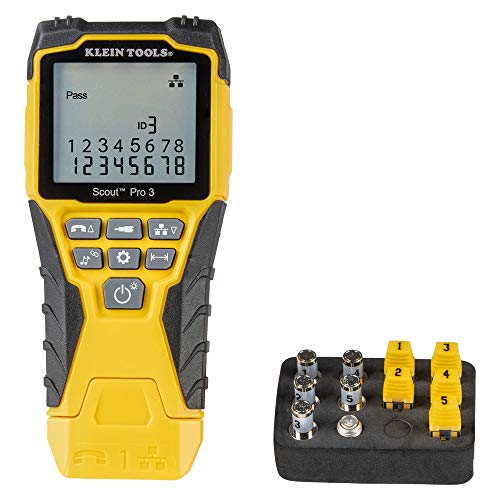
For professionals who need reliable and accurate cable testing, the Klein Tools Cable Tester Kit with Scout Pro 3 stands out as an essential tool. It tests voice, data, and video cables, providing thorough fault detection for issues like Open and Short faults. You can measure cable lengths up to 2000 feet, ensuring precision in your assessments. The backlit LCD screen displays cable length, wiremap, and test results for easy readability. Plus, with features like cable tracing using a tone generator and hub blink mode, managing multiple cable runs becomes efficient. The kit even includes five locator remotes for enhanced testing capabilities.
Best For: Professionals in the telecommunications and networking industries who require reliable and efficient cable testing solutions.
Pros:
- Comprehensive testing capabilities for voice, data, and video cables with fault detection.
- Measures cable lengths up to 2000 feet for accurate assessments.
- Backlit LCD screen enhances readability in various lighting conditions.
Cons:
- Tone generator for cable tracing sold separately, adding to overall cost.
- May be overwhelming for beginners due to its extensive features.
- Five locator remotes may be excessive for smaller projects or users with fewer cables.
Mackie Cable Tester (MTest-1)

Mackie Cable Tester (MTest-1) stands out as the ideal choice for audio professionals seeking reliability in their gear. You’ll appreciate its ability to test commonly used connector types in both live sound and studio applications. The 5-way switch allows you to quickly verify each pin, while the supplied probes enable manual continuity checks. Powered by a single 9V battery, this tester is designed for convenience. Its built-like-a-tank construction guarantees it can handle the rigors of daily use, making it a dependable tool in your kit. Don’t miss the product details for even more insights into this exceptional tester.
Best For: Audio professionals seeking a reliable and durable cable testing solution for live sound and studio applications.
Pros:
- Easily tests commonly used connector types with a quick 5-way switch.
- Allows for manual continuity checks with supplied probes, enhancing versatility.
- Built-like-a-tank construction ensures long-lasting durability under rigorous use.
Cons:
- Requires a 9V battery, which may need frequent replacements if used regularly.
- Limited to testing only specific connector types, which may not cover all user needs.
- May lack advanced features found in more expensive cable testers.
MFL. 15-Plug Audio Cable Tester Line Finder

Designed with audio professionals in mind, the MFL 15-Plug Audio Cable Tester Line Finder offers an impressive 15-in-1 functionality that makes it an essential tool for anyone troubleshooting audio cables. This tester features a user-friendly 10-way switch and LED indicators that confirm conductor connections, allowing you to test up to 13 cables simultaneously. Its heavy-duty metal construction guarantees durability, making it perfect for both studio sessions and live performances. While it lacks advanced features like signal strength testing, users rave about its reliability and effectiveness, making it a valued investment for audio professionals and enthusiasts alike.
Best For: Audio professionals and enthusiasts looking for a reliable and efficient tool to troubleshoot and test various audio cables.
Pros:
- Versatile Testing: Supports a wide range of connectors and allows testing of up to 13 cables simultaneously.
- Durable Design: Heavy-duty metal construction ensures longevity and reliability in various environments.
- User-Friendly: Features a clear 10-way switch and LED indicators for easy operation and quick identification of cable issues.
Cons:
- Limited Features: Lacks advanced functionalities such as signal strength indication and phantom power testing.
- Basic Testing Capabilities: Focuses primarily on continuity rather than performance quality of cables.
- Insufficient Instructions: Does not provide detailed guidance for more complex testing scenarios.
Klein Tools VDV526-200 Cable Tester for Ethernet Cables
Product not found or API error.
The Klein Tools VDV526-200 Cable Tester stands out as an ideal choice for network technicians and IT professionals who need a reliable tool for testing Ethernet cables. This compact tester supports CAT 5e and CAT 6/6A cables, ensuring versatility for various data connections. With its large backlit LCD, you can easily read pin-to-pin wiremap results, even in low-light conditions. It detects faults like Open, Short, and Miswire efficiently. Plus, the multiple tone generation options enhance your ability to trace cables. The auto power-off feature helps conserve battery life, making it perfect for on-the-go testing.
Best For: Network technicians and IT professionals seeking a reliable and versatile tool for testing Ethernet cables.
Pros:
- Large backlit LCD display for easy reading in low-light conditions.
- Comprehensive fault detection capabilities for various wiring issues.
- Compact design with auto power-off feature for battery conservation.
Cons:
- Requires a separate probe for tone generation functions.
- Limited to testing only RJ45 terminated cables and patch cords.
- May not cover advanced testing features found in higher-end models.
Multifunction RJ45 Network Cable Tester

For network technicians and IT professionals, the Multifunction RJ45 Network Cable Tester of 2025 is an essential tool that simplifies cable management. This tester supports UTP, STP, RJ45, and RJ11 continuity tests, quickly identifying faults at near-end, mid-end, and far-end connections. With a cable length measurement of up to 600M, you can switch between meters and feet effortlessly. Its digital signal tracer cuts through clutter, while the built-in Optical Power Meter measures signal power accurately. Plus, you’ll appreciate PoE testing capabilities for up to 60V, ensuring your network runs smoothly. This tool truly enhances your efficiency on the job.
Best For: Network technicians and IT professionals looking for a reliable tool to test and manage various types of network cables efficiently.
Pros:
- Versatile testing capabilities for UTP, STP, RJ45, and RJ11 cables, making it suitable for different networking environments.
- Advanced features such as cable length measurement and digital signal tracing enhance troubleshooting efficiency.
- Built-in Optical Power Meter and PoE testing support ensure comprehensive testing for both data and power over Ethernet applications.
Cons:
- The complexity of features may be overwhelming for beginners or less experienced users.
- Requires careful handling as some components may be sensitive to physical stress or environmental conditions.
- Limited to a maximum cable length of 600M, which may not meet the needs of larger installations.
Factors to Consider When Choosing Cable Testers
When choosing a cable tester, you’ll want to take into account several key factors. Think about cable compatibility, testing features, and the user interface, as these can greatly affect your experience. Also, don’t overlook portability and power source requirements to make sure the tester fits your needs.
Cable Compatibility and Types
Choosing the right cable tester hinges on compatibility with the specific cable types you’ll encounter. Make sure it supports RJ11/12 for voice, RJ45 for data, and coax F-connectors for video applications. If you work with various audio and data formats, look for testers that can handle XLR, TRS, and USB connections. It’s also essential to choose testers that can check continuity and identify faults across cable formats like UTP/STP for networking. Accurate length measurement is important, especially for longer runs, to aid troubleshooting and installations. Finally, opt for testers with a wide range of connector compatibility, allowing you to test multiple cable types simultaneously for efficient diagnostics.
Testing Features and Capabilities
A reliable cable tester must go beyond compatibility; it should also offer a range of testing features and capabilities that enhance your troubleshooting efforts. Look for testers that can identify faults like Open, Short, Miswire, and Split-Pair, ensuring thorough cable integrity testing. Length measurement features are essential too, as they accurately gauge cable lengths, improving your setup and troubleshooting efficiency. Choose devices that cater to various cable types—like RJ11/12, RJ45, and coaxial—so you won’t need multiple testers. Additionally, consider functionality such as tone generation for cable tracing and PoE testing, which boosts versatility across different networking environments. These features will streamline your work and make your testing processes more effective.
Display and User Interface
Many users overlook the importance of the display and user interface when selecting a cable tester, but these features can greatly impact your testing experience. A large backlit LCD display enhances readability, especially in low-light conditions, making it easier to use in various environments. You’ll appreciate an intuitive user interface with clear button layouts, allowing quick access to testing functions and results, which reduces the learning curve. Visual indicators, like LED lights, provide immediate feedback on cable continuity and connection status, helping you troubleshoot quickly. Additionally, some testers offer multi-language support, catering to diverse users. Compact designs with auto power-off features also conserve battery life, ensuring your device is ready when you need it most.
Portability and Design
Portability and design are key factors that can make or break your experience with a cable tester. You’ll want a model that’s compact and lightweight, making it easy to carry to job sites or events. Durability is equally important; the tester should withstand the wear and tear of regular transport and various environmental conditions. Look for ergonomic features like a comfortable grip and an intuitive layout to enhance your efficiency while on the go. A backlit display is essential for visibility in low-light situations, allowing you to read results with ease. Battery-powered options are also a must, ensuring you can test cables in outdoor or remote locations without needing a constant power source.
Power Source Requirements
When selecting a cable tester, one essential aspect to evaluate is its power source, as it directly impacts your testing experience. Many testers, especially for audio applications, operate on a standard 9V battery, which may not be included, so you might need to purchase batteries separately. Alternatively, some testers come with rechargeable batteries or USB charging options, offering you convenience and an environmentally friendly power source. Battery life can vary considerably; advanced models often feature auto power-off to save energy. Consider the power source based on your intended use—portable testers typically rely on battery operation for mobility. Finally, check the voltage requirements to verify compatibility, especially if you’re working with higher voltage applications like Power over Ethernet (PoE).
Build Quality and Durability
Build quality and durability are essential factors to take into account in cable testers, especially if you’re using them in demanding environments. Look for sturdy construction with heavy-duty materials that can handle frequent use, whether in live performances or fieldwork. Metal casings often offer better durability than plastic, minimizing damage from drops. If you plan on outdoor use, choose weatherproof designs to keep moisture and dust at bay. Check that the LED indicators are clear and resilient, ensuring they won’t fade or malfunction over time. Finally, consider the tester’s weight; while heavier models may indicate robust construction, lightweight options can still provide solid build quality. Prioritize these features for lasting performance and reliability.
Price and Value Proposition
While evaluating cable testers, it’s essential to weigh the price against the features they offer. Some testers may seem overpriced when compared to similar products with advanced functionalities. Look closely at user feedback regarding reliability and performance; positive reviews often indicate a worthwhile investment, even if the price is higher. Consider the long-term cost-effectiveness of a more expensive model, as it might save you time and money on repairs down the line. Bundled features, like built-in reporting or multi-cable testing capabilities, can justify a higher initial price. Finally, assess whether included accessories, such as remotes or additional connectors, enhance the tester’s overall functionality, providing additional value without extra costs.
Additional Functionality and Extras
Choosing the right cable tester involves more than just evaluating its basic functions; you should also consider additional features that can enhance your testing experience. Look for testers that offer multiple capabilities like continuity checks, fault detection (open, short, miswire), and cable length measurement to boost versatility. Advanced models may include tone generation, which helps trace cables efficiently, cutting down troubleshooting time. A backlit LCD display is essential for visibility in low-light situations, ensuring ease of use. Also, consider testers with PoE testing for verifying power over Ethernet connections. Integrated features like hub blink mode can simplify identifying port locations on switches, improving network management and cable organization. These extras make a significant difference in your daily tasks.


