

Looking to enhance your technology projects? Explore the Waveshare 8-Ch Analog Acquisition Module, which offers 12-bit precision for accurate data capture.
The versatile 0-5V/0-10V Converter is ideal for reliable PWM outputs, making it perfect for automation applications.
For gaming or robotics, the hiBCTR Joystick Module introduces dual-axis control, adding interactivity to your designs.
Additionally, consider the Analog Voltage to PWM modules for precise signal adjustments.
Each module boasts unique advantages. Discover how these cutting-edge options can elevate your work in automation, robotics, and beyond, and what factors to consider when selecting the right modules for your needs.
Waveshare 8-Ch Analog Acquisition Module, 12-Bit

The Waveshare 8-Ch Analog Acquisition Module is an excellent choice for engineers and developers interested in high-precision data acquisition within various technological domains such as automation and robotics. This 12-bit module is versatile, supporting both voltage and current acquisition across eight channels, allowing for the measurement of currents up to 20mA in single-ended and differential modes. With a wide voltage supply range (DC 7–36V), it adapts seamlessly to different project requirements. Onboard isolation features contribute to signal reliability, while surge protection and a built-in digital filtering algorithm ensure high accuracy and stability. Its rail-mount design and configurable device addressing simplify installation, making it easy to stack and cascade multiple devices for complex systems.
Best For: Engineers and developers seeking a reliable, high-precision data acquisition solution for diverse applications in automation, robotics, and AI advancements.
Pros:
- High precision: 12-bit resolution guarantees accurate data collection.
- Versatile input options: Supports both single-ended and differential input modes across eight channels.
- Robust protection features: Includes surge protection and onboard isolation for enhanced reliability.
Cons:
- Limited current range: Maximum current measurement is capped at 20mA, which may not be suitable for all applications.
- Complexity in setup: Configuring multiple devices on the RS485 bus may require additional technical expertise.
- Rail-mount design: May not fit all installation environments, potentially limiting flexibility.
0-5V/0-10V Converter Module Analog Input Voltage to PWM 2KHZ-20KHZ

For technology enthusiasts and automation engineers seeking precision in control, the 0-5V/0-10V Converter Module is an excellent choice. This module effectively converts analog input voltage into PWM outputs, operating within a range of 2kHz to 20kHz. Users can seamlessly switch between PNP-PWM and NPN-PWM outputs using a convenient jumper, while DIP switches allow for the selection of direct or inverse output ratios, providing flexibility for a variety of applications. Its precise transformation of 0-10V signals enhances diverse systems, including PLC configurations, motor speed control, and LED dimming. Constructed with military-spec PCB, it boasts a rugged and reliable design, making it ideal for industrial environments such as HVAC control and CNC machinery.
Best For: Technology professionals and OEMs looking for a dependable solution to convert analog signals to PWM outputs across various industrial and automation applications.
Pros:
- Versatile Output Options: Easily switch between PNP-PWM and NPN-PWM configurations to cater to different requirements.
- Precision Control: Delivers accurate conversion of 0-10V signals, perfect for PLC systems and motor speed management.
- Durable Design: Crafted with military-spec PCB and overvoltage protection, ensuring reliability in challenging environments.
Cons:
- Limited Frequency Range: PWM output is confined to 2kHz-20kHz, which may not fulfill all application needs.
- Requires Configuration: Users must set jumpers and DIP switches, which could complicate the setup process for some.
- Technical Support Dependency: While support is readily available, users may need to rely on it for troubleshooting and advanced configurations.
hiBCTR 2-Pack Joystick Module KY-023, Dual-Axis XY Analog
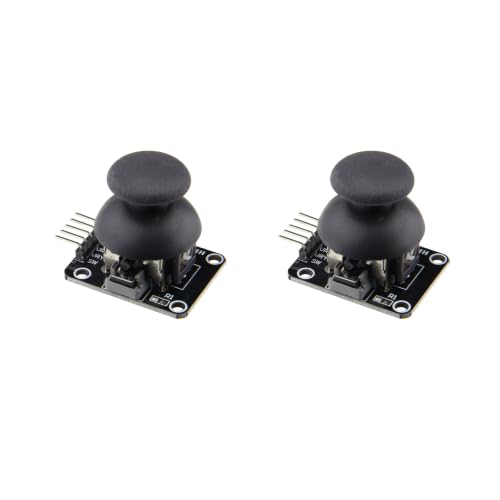
Ideal for tech enthusiasts and professionals alike, the hiBCTR 2-Pack Joystick Module KY-023 provides precise dual-axis control for various applications, including automation and robotics. Featuring two independent 10K potentiometers, this module ensures smooth analog output for both X and Y axes. Operating on a 5V supply, it is centered at 2.5V, allowing for a full range from 0V to 5V. The integrated push-button enhances versatility, enabling Z-axis functions for tasks like selection or mode-switching. Compatible with platforms such as Arduino, Raspberry Pi, and ESP32, this joystick is ideal for custom gamepads, remote controls, and robotic arms. Its durable design ensures reliable performance across a variety of tech projects.
Best For: Tech enthusiasts, students, and professionals seeking versatile joystick control in innovative electronics projects.
Pros:
- Smooth Dual-Axis Control: Delivers precise analog output with independent potentiometers for X and Y axes.
- Integrated Push-Button: Adds extra functionality for Z-axis control, improving usability in diverse applications.
- Wide Compatibility: Easily integrates with popular microcontrollers like Arduino and Raspberry Pi, making it suitable for a broad range of projects.
Cons:
- Limited Voltage Range: Operates solely on a 5V supply, which may limit use in certain applications requiring different voltage levels.
- Potential Wear Over Time: Mechanical components may deteriorate with extensive use, affecting longevity.
- Requires Basic Programming Knowledge: Users need some familiarity with coding to fully leverage the joystick’s features in their projects.
Analog Voltage to PWM Converter Module
Transform Analog Voltage to PWM Signals with Ease
Are you seeking an efficient solution to convert analog voltage into PWM signals? The Analog Voltage to PWM Converter Module is designed for you. It supports input voltages of 0-5V or 0-10V, producing PWM signals within a frequency range of 2KHz to 20KHz. Its adjustable output frequency allows you to tailor it to your specific project needs, making it an essential tool for automation, robotics, and various AI applications.
This module shines in areas such as PWM motor speed control and instrumentation AD interface conversion. With both PNP and NPN output options available at 5V and 24V, its versatility is unmatched. Crafted by Garosa, it ensures quality and reliable customer support for your peace of mind.
Ideal For: Engineers and hobbyists focusing on converting analog signals into PWM for motor control and automation projects.
Pros:
- Accommodates versatile input ranges of 0-5V and 0-10V.
- Adjustable output frequency for project-specific customization.
- Multiple output types (PNP and NPN) for diverse application scenarios.
Cons:
- Frequency range may be limited for applications needing very high PWM frequencies.
- Manual frequency adjustment might not suit automated setups.
- Integration could be complex for beginners unfamiliar with PWM signals.
Analog Voltage to PWM Converter Module

The Analog Voltage to PWM Converter Module is an excellent choice for projects that demand precise control in areas such as automation and robotics. It effectively converts 0-5V or 0-10V analog inputs into a 0-100% PWM signal, enabling seamless management of various devices. With a default output frequency of 2kHz, which can be adjusted up to 20kHz, you can customize it to meet specific application needs. The module offers a choice between PNP-PWM and NPN-PWM outputs, with the latter capable of supporting both 5V and 24V levels. Its versatility makes it ideal for motor control, instrument interfaces, and other voltage-to-PWM applications, significantly boosting your project’s performance.
Best For: Individuals looking for precise control in motor speed applications and voltage-to-PWM conversions, particularly within the fields of automation and robotics.
Pros:
- Versatile output options: Supports both PNP-PWM and NPN-PWM configurations suitable for various applications.
- Adjustable frequency: Offers a customizable output frequency ranging from 2kHz to 20kHz.
- Wide input range: Capable of converting 0-5V or 0-10V analog signals into PWM for different devices.
Cons:
- Power supply requirements: NPN output necessitates an additional 24V power supply for 24V output functionality.
- Limited to specific voltage inputs: Only compatible with designated voltage ranges (0-5V or 0-10V).
- Potential complexity: May require additional setup for optimal performance in certain applications.
4Pcs Dual-axis Joystick Module for PS2 Controllers

If you’re a tech enthusiast or developer, the 4Pcs Dual-axis Joystick Module for PS2 Controllers is a remarkable addition to your toolkit. This module provides precise analog outputs for both X and Y axes, alongside a digital output for the Z axis. Operating within a 3.3V to 5V range, it’s ideal for a variety of innovative projects in automation, robotics, and gaming. As you manipulate the joystick, the voltage varies from approximately 2.5V to 5V or down to 0V, enhancing responsiveness for interactive applications. Its compatibility with sensor expansion boards makes it an excellent choice for replacing game controller sensors or developing custom joystick controls. Elevate your projects across multiple technology domains with this versatile module!
Best For: Tech enthusiasts and developers seeking a flexible joystick module for interactive automation, robotics, and gaming projects.
Pros:
- High precision with analog outputs for smooth control in both X and Y axes.
- Compatible with sensor expansion boards, broadening project possibilities.
- Easy integration into various applications, including custom game controllers and robotic interfaces.
Cons:
- Requires an external power supply (DC 3.3V to 5V), which may complicate certain setups.
- Limited to specific applications that may not meet all users’ needs.
- Potential learning curve for beginners unfamiliar with joystick integration in tech projects.
Arduino Pro Opta Analog Expansion Module (AFX00007)
Product not found or API error.
For engineers exploring reliable solutions in automation, robotics, and AI advancements, the Arduino Pro Opta Analog Expansion Module (AFX00007) is an exceptional choice. This compact module features six programmable inputs, two analog outputs, and four PWM channels, providing versatility for a wide range of projects. Its snap-on DIN rail design facilitates straightforward installation, while compatibility with Arduino Cloud and IEC 61131-3 PLC IDE makes programming intuitive. Adhering to industrial-grade standards, it is certified by FCC, CE, and RoHS, ensuring dependable performance even in challenging environments. With the capability to manage up to five modules, scaling your automation systems for enhanced control and monitoring in IoT applications is seamless.
Best For: Engineers and developers seeking a versatile and reliable solution across automation, robotics, and IoT applications.
Pros:
- Versatile Inputs/Outputs: Provides 6 programmable inputs, 2 analog outputs, and 4 PWM channels to meet diverse project demands.
- Easy Installation: The snap-on DIN rail design simplifies setup, enabling quick deployment in various industrial contexts.
- Scalable Design: Supports management of up to 5 modules for expanded I/O capabilities, ideal for sophisticated automation systems.
Cons:
- Limited Analog Outputs: The availability of only 2 analog outputs may limit certain advanced applications requiring more flexibility.
- Dependency on Compatibility: Users need to be familiar with Arduino IDE and IEC 61131-3 PLC IDE for optimal functionality.
- Potentially Overkill for Simple Projects: The extensive features could exceed the needs of simpler applications, introducing unnecessary complexity.
Factors to Consider When Choosing Analog Input Modules
When selecting analog input modules for your automation or robotics projects, several key factors should be taken into account. Begin by assessing the specifications and features that best fit your project requirements, such as input voltage range and output types. Additionally, it’s crucial to consider signal accuracy and protective mechanisms, as these elements can significantly influence the performance and reliability of your system. Staying informed about the latest advancements in AI and technology can also enhance your decision-making process.
Key Specifications and Features
Selecting the right analog input module is crucial for effective data acquisition in various technological applications, including automation and robotics. Start by considering the number of channels; having more channels enables the simultaneous capture of multiple signals, which is particularly beneficial in complex systems. Next, assess the input voltage and current ranges to ensure they align with your specific application needs for precise readings. Isolation features are also essential—opt for voltage and signal isolation to enhance reliability and reduce interference, especially in industrial environments.
Data acquisition accuracy is another key factor; higher resolutions, such as 12-bit, allow for detailed data capture, which is vital in advanced AI applications. Lastly, review the available output configurations, like PWM or analog voltage outputs, to ensure compatibility with your control systems and overall application requirements. Each specification plays a significant role in optimizing your project across the diverse fields of technology.
Input Voltage Range
Understanding the input voltage range is crucial in the realm of technology, particularly in automation and robotics, as it dictates the types of signals your analog input module can effectively process. Typically, these ranges span from 0-5V or 0-10V. Opting for a module with a wider range enhances versatility, enabling connections to various sensors and devices across different applications. Some modules even provide dual input voltage options, allowing customization based on your specific requirements.
It’s essential to consider that the accuracy and resolution of your readings may be influenced by the voltage range; modules designed for narrower ranges tend to offer higher precision. Matching the module’s input voltage range with the expected output of your devices is vital to prevent damage and ensure optimal performance in your projects—especially in fields like AI advancements, where precision is paramount.
Output Types and Configurations
After considering the input voltage range, it’s essential to explore the output types and configurations that analog input modules offer, particularly in the context of automation and robotics. Many of these modules provide a variety of output options, such as PWM (Pulse Width Modulation) and direct voltage outputs, making them adaptable for different control systems across various applications. You’ll encounter configurations like PNP and NPN outputs, which ensure compatibility with a wide range of devices based on your voltage requirements. Some modules even include dual outputs or selectable output ratios, enhancing versatility for tasks like motor control. Additionally, adjustable frequency settings, typically ranging from 2kHz to 20kHz, allow for performance fine-tuning. Integrated features such as push-button controls and multi-channel capability can simplify user interaction, thereby expanding functionality in practical applications, especially in the realms of automation and AI advancements.
Signal Accuracy and Precision
When evaluating analog input modules in the context of automation, robotics, and AI advancements, signal accuracy and precision are crucial for ensuring that your measurements accurately reflect real-world values. High-precision modules typically utilize zero-drift operational amplifiers to minimize errors. It’s also important to consider the resolution of the analog-to-digital converter (ADC); for instance, a 12-bit converter offers 4096 discrete values, enhancing the granularity of your signals.
Additionally, think about the input modes you’ll be utilizing; differential inputs can significantly improve accuracy by reducing noise and interference from common-mode signals, which is especially important in complex robotic systems. Calibration procedures are vital as they help adjust the system to account for any discrepancies in your measurement setup, ensuring the reliability of your data. Finally, employing digital filtering techniques such as oversampling can further enhance signal quality, mitigating noise and clarifying your acquired data, ultimately leading to more dependable results in your technology-driven projects.
Isolation and Protection Mechanisms
As you prioritize signal accuracy and precision in your technology projects, particularly in automation and robotics, it’s essential not to overlook the role of isolation and protection mechanisms in analog input modules. Effective isolation techniques, such as unibody power supplies and magnetic isolation, enhance signal reliability while safeguarding against electrical interference. Surge protection features, including resettable fuses and Transient Voltage Suppressors (TVS), shield your module from over-voltage, over-current, and even lightning strikes, ensuring resilience in various environments.
Moreover, employing high-precision resistors and zero-drift operational amplifiers is crucial for accurate data acquisition, particularly in noisy settings common in industrial automation. Digital filtering techniques, such as oversampling algorithms, further minimize noise, enhancing measurement fidelity. By integrating robust isolation and protection mechanisms, you can significantly improve the longevity and reliability of your analog input modules, making them invaluable in demanding applications across the fields of automation, robotics, and AI advancements.
Compatibility With Microcontrollers
Choosing the right analog input module is essential for seamless integration with microcontrollers, particularly in diverse technological fields like automation, robotics, and AI advancements. First, ensure the module features a compatible interface, such as a standard pin configuration, for straightforward connections in various applications. Next, confirm that the operating voltage range aligns with your microcontroller’s power requirements. Look for modules that support common communication protocols like I2C, SPI, or RS485, as this enhances flexibility across different projects. Additionally, verify that the output types—whether analog voltage or PWM—are compatible with your microcontroller’s input capabilities. Lastly, consider the availability of libraries or documentation for the module, which can greatly simplify programming and accelerate your development process in these cutting-edge areas of technology.


